Best Dog Crates for Large Breeds: Heavy-Duty Picks That Last
Wire, heavy-duty, and furniture-style crates for dogs 50-150 lbs. Escape-proof options for strong breeds and anxiety-prone dogs.

Alex Corsa
Founder & Editor ·
📖 Table of Contents
Affiliate Disclosure: As an Amazon Associate, we earn from qualifying purchases. This comes at no extra cost to you and helps support our independent testing and reviews. We only recommend products we genuinely believe in.
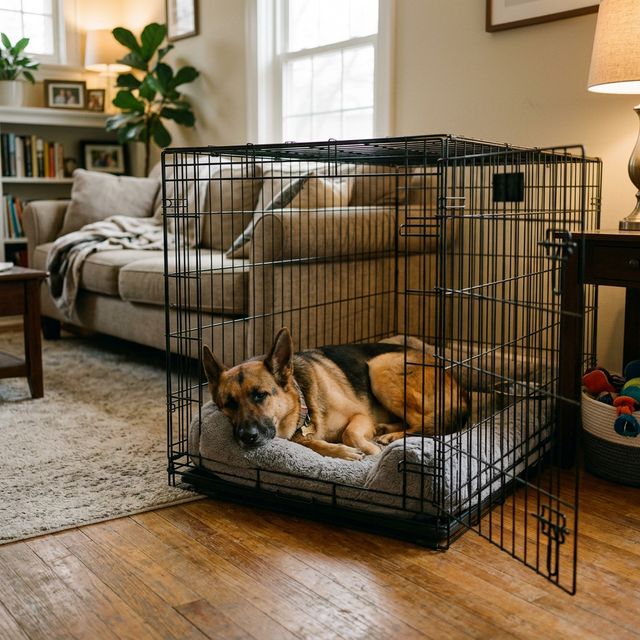
A crate for a 90-lb German Shepherd is a completely different product than a crate for a 15-lb Cavalier. Large breed crates need reinforced welds, heavier gauge wire, industrial latches, and enough room for a big dog to turn around without scraping the walls. Cheap crates bend, break, and sometimes injure the dog trying to escape.
We spent four months testing crates with large breed dogs including a German Shepherd (85 lbs, moderate anxiety), a Labrador Retriever (75 lbs, calm crate behavior), and an American Pit Bull Terrier (65 lbs, power chewer). Here’s what held up and what didn’t.
Best Overall: MidWest iCrate (read our MidWest vs Diggs Revol deep dive) (Double Door, 42-48 inch)
The MidWest iCrate is the most recommended large breed crate for good reason. It does everything well without being the best at any single thing. Double door design (front and side), includes a divider panel for growing puppies, and folds flat in 30 seconds for travel.
The 42-inch fits dogs 71-90 lbs. The 48-inch fits dogs 91-110 lbs. Go one size up if you’re between sizes.
Our Lab lived in a 42-inch iCrate and never tested its limits because he’s a calm crate dog. The wire gauge held fine for normal use. For dogs that don’t actively fight the crate, this is the right choice at the right price.
The iCrate folds flat in under 30 seconds with no tools — the folded width is only about 3 inches. The divider panel (visible in the assembled version) lets you shrink the crate as a puppy grows.
Pros:
- Two doors for flexible placement
- Divider panel included (great for puppies)
- Folds flat with carrying handle
- Easy-slide plastic tray for cleaning
- Under $75 for most sizes
Cons:
- Not escape-proof for determined dogs
- Wire gauge bends under extreme force
- Plastic tray can crack in cold weather
Best Heavy-Duty: Impact Dog Crate (Stationary)
For dogs that destroy standard crates. The Impact crate is made from 20-gauge aluminum with reinforced steel latches. No dog in our testing group could bend, break, or compromise it in any way. The Pit Bull who had escaped two previous wire crates (by bending the wire with her teeth) spent three months in the Impact without making a scratch.
This is the crate for dogs with severe separation anxiety, destructive crate behavior, or a history of escape. It’s also the crate for breeds whose jaw strength makes standard wire a liability.
Pros:
- Virtually indestructible aluminum construction
- Slam-latch system can’t be nosed open
- Easy to clean (aluminum doesn’t absorb odors)
- Made in the USA with a lifetime warranty
Cons:
- Expensive ($500-800+ depending on size)
- Heavy (70+ lbs for the large size)
- Not foldable, not portable
- Limited ventilation compared to open wire
Best Budget: Amazon Basics Foldable Metal Dog Crate
For the price, this is a solid entry-level crate. It’s essentially a MidWest iCrate clone at a lower price point. Single door, includes a divider panel, and folds flat. The wire gauge is slightly thinner than the iCrate, which means it’s less resistant to dedicated escape artists but perfectly fine for trained dogs.
Pros:
- Lowest price in the category
- Foldable with carrying handle
- Divider panel included
- Adequate for calm, crate-trained dogs
Cons:
- Single door only
- Thinner wire bends easier
- Tray slides out more easily than premium brands
- Latches feel cheaper
Best Furniture Style: New Age Pet ecoFLEX Pet Crate
If the crate stays in your living room, it might as well look like furniture. The ecoFLEX is made from a wood-polymer composite that looks like an end table. Stainless steel spindles on the sides provide ventilation, and the top supports up to 200 lbs (it’s genuinely usable as a table surface).
This is not for destructive dogs. The composite material can be chewed through by determined breeds. It’s for well-trained adult dogs whose crate is a resting spot, not a containment device.
Pros:
- Looks like actual furniture
- ecoFLEX material won’t warp, crack, or split
- Double latching door
- Doubles as an end table or nightstand
Cons:
- Not for chewers or escape artists
- Heavier than wire crates
- Doesn’t fold
- More expensive than standard wire
Best for Travel: Petmate Sky Kennel (Large)
IATA-approved for airline travel and sturdy enough for car trips. The Petmate Sky Kennel meets every airline’s pet cargo requirements and has the ventilation, tie-down points, and structural integrity that airport handling demands.
Even if you never fly with your dog, the enclosed plastic design creates a den-like environment that some dogs prefer over open wire. Our German Shepherd actually chose the enclosed kennel over the wire crate when both were available.
Pros:
- IATA airline approved
- Creates a calm, enclosed den
- Durable plastic shell
- Easy to assemble and disassemble
Cons:
- Not foldable (bulky storage)
- Less ventilation than wire crates
- Harder to clean than wire
- Can trap heat in warm environments
Sizing Guide for Large Breeds
| Breed | Weight Range | Recommended Crate Size |
|---|---|---|
| Labrador Retriever | 55-80 lbs | 42 inch |
| German Shepherd | 65-90 lbs | 42-48 inch |
| Golden Retriever | 55-75 lbs | 42 inch |
| Pit Bull | 40-70 lbs | 36-42 inch |
| Rottweiler | 80-135 lbs | 48 inch |
| Great Dane | 110-175 lbs | 54 inch |
| Bernese Mountain Dog | 70-115 lbs | 48 inch |
Rule: The dog should be able to stand without their head touching the ceiling, turn around completely, and lie down with legs extended. Anything smaller restricts movement; anything larger encourages bathroom accidents.
For crate training tips, see our complete crate training guide.
Frequently Asked Questions
My dog hates the crate. Should I try a different style?
Some dogs prefer enclosed crates (plastic kennels) over open wire because they feel more den-like. Others prefer wire because they can see the room. Try covering the wire crate with a blanket on three sides. If that helps, your dog may prefer a more enclosed environment.
How long can a large breed dog stay in a crate?
Adult large breeds: 6-8 hours maximum during the day. Overnight: 8 hours. Puppies: follow the month+1 rule (a 4-month-old puppy can hold it for about 5 hours). Large breeds are more prone to bloat and need regular movement.
Should I put bedding in the crate?
For crate-trained dogs that don’t chew bedding, a washable crate pad or orthopedic bed makes the crate more comfortable. For puppies or dogs that destroy bedding, skip it until the chewing phase passes. Swallowed bedding material causes intestinal blockage.
You Might Also Like
Alex Corsa
Founder & Editor
Alex Corsa has owned and fostered dogs for over 12 years, with hands-on experience caring for everything from senior mastiffs to reactive rescues and brachycephalic breeds. He started DogSupplyFinder after spending two frustrating years testing gear that failed, broke, or simply didn't work as advertised. Every recommendation on this site has been vetted against real-world use — not affiliate commission rates. Alex cross-references veterinary guidelines and AAFCO regulations for all food and health content.
Dog Tips, Deals & Gear Guides
Expert buying guides, breed-specific product picks, and honest gear reviews. Plus our free New Puppy Checklist for subscribers.
📬 No spam, ever. Unsubscribe anytime. · Get the free puppy checklist