Best Dog ID Tags: Engraved, QR Code, and Smart Tags Compared
Compare the best dog ID tags from engraved to smart QR code options. Prices, durability, and features reviewed to keep your pet safe.

DogSupplyFinder Research Team
Product Research ·
📖 Table of Contents
Affiliate Disclosure: As an Amazon Associate, we earn from qualifying purchases. This comes at no extra cost to you and helps keep the DogSupplyFinder editorial desk publishing research-based guides. Recommendations come from specs and owner reports, not an in-house lab or a test fleet. See How We Make Money.
A dog ID tag costs between five and thirty dollars. A lost dog without one can cost you weeks of searching, hundreds in shelter fees, and an experience you don’t want to go through. The math isn’t complicated.
But the tag market has changed. Traditional engraved tags now compete with QR code tags that link to live digital profiles, smart tags with GPS capabilities, and even NFC-enabled options that share your contact information with a phone tap. The question isn’t whether to tag your dog - it’s which technology makes sense for your situation.
After comparing dozens of options across engraved, QR, smart, and GPS categories, here’s a breakdown of what works, what doesn’t, and what’s worth the money.
Types of Dog ID Tags
Engraved Tags
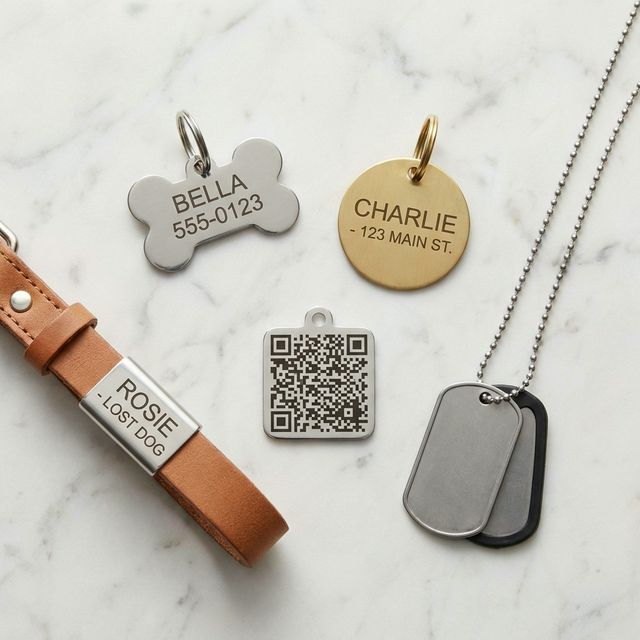
The original. Metal or plastic tags with your dog’s name and your phone number stamped, laser-etched, or machine-engraved into the surface. They work without batteries, apps, or internet access. Anyone who picks up your dog can read the tag immediately.
Cost: $5-$15 Battery: None Subscription: None
QR Code Tags
Small tags with a printed or laser-engraved QR code. A finder scans the code with any smartphone camera and gets directed to your dog’s online profile - which can include multiple phone numbers, medical information, photos, and even GPS location of the scan.
Cost: $10-$30 Battery: None (the tag itself) Subscription: Free basic profiles; $3-$10/month for advanced features
Smart / GPS Tags
Collar-mounted devices that provide real-time location tracking through an app. These go beyond identification - they actively track your dog’s position, set up virtual fences, and alert you if your dog leaves a designated area.
Cost: $48-$500+ for the device Battery: Requires charging every 1-14 days Subscription: $5-$15/month for cellular service
Best Engraved Tags
GoTags Stainless Steel Pet ID Tags
The most popular engraved tag on Amazon for good reason. Available in bone, circle, heart, and rectangle shapes with up to four lines of custom engraving. Stainless steel construction resists rust, scratching, and fading.
GoTags offers deep laser engraving rather than surface etching, which means the text stays readable even after years of daily wear. The edges are deburred and smooth - no sharp points to catch on fabric or scratch skin.
Price: Around $5-$8 depending on size and shape Best for: Dogs of all sizes who need reliable, low-maintenance identification
Road iD Pet Tag
Built by the same company that makes athletic ID bracelets for runners and cyclists. These tags use a silicone mount that reduces jingling and prevents the tag from spinning. Available in several colors with customizable engraving on both sides.
Road iD tags include a unique serial number linked to an online profile, giving you a basic digital backup to the physical engraving. If the engraving wears down, the serial number still works.
Price: Around $20 Best for: Active dogs and owners who want extra durability and reduced noise
Slide-On Collar Tags
These tags slip directly onto the collar webbing instead of hanging from a ring. No dangling, no jingling, no snagging on branches or crate wire. The tag lies flat against the collar.
Several brands make slide-on options. Look for laser-engraved stainless steel versions that won’t wear smooth. The main limitation is collar width - measure your collar before ordering.
Price: $8-$15 Best for: Dogs who get caught on things, working dogs, or owners who can’t stand jingling
Best QR Code Tags
Supernormal PawTag
A standout in the QR tag category. The tag links to a live pet profile that you can update anytime - add new phone numbers, update your address after a move, or add medical information. When someone scans the QR code, you receive a notification with the scan location.
The premium plan adds proactive lost pet alerts that notify nearby PawTag users if you mark your dog as missing. Think of it as a community-powered search network built into a tag.
Price: Tag around $20; premium features require subscription (around $5-$8/month) Best for: Owners who travel frequently, move often, or want the ability to update contact information without buying a new tag
Shiloh’s House QR Tags
Waterproof, UV-proof, and odor-resistant. These silicone QR tags link to a customizable pet profile that you can update for free - no app download, no subscription for basic features. The finder just scans and sees your information.
What separates Shiloh’s House from competitors is the no-subscription approach. The core functionality - scan a QR code, see the pet profile - works forever without monthly fees.
Price: Around $15-$20 Best for: Budget-conscious owners who want digital tag features without recurring costs
dogIDs QR Code Tags
Available in both traditional hanging tags and collar-embedded ribbon options. The QR code links to a customizable profile. Stainless steel construction on the hanging tag version. The collar-embedded option weaves the QR code directly into the collar material.
Price: $12-$25 Best for: Owners who want the QR code integrated into the collar rather than as a separate hanging tag
Best GPS Trackers
Fi Series 3+ Smart Collar
The Fi collar has become the go-to GPS tracker for dog owners who want reliable location tracking without fuss. The Series 3+ offers real-time GPS tracking, activity monitoring, sleep tracking, and a Lost Dog Mode that increases tracking frequency and alerts your contacts.
Battery life is the standout feature: up to 3+ months in standard mode, one month in GPS tracking mode. That’s dramatically better than most competitors.
Price: Collar module around $149; subscription from $8/month (or $99/year) Best for: Owners who want set-it-and-forget-it tracking with minimal charging
Tractive GPS Tracker
Clips onto any existing collar. Tractive provides real-time GPS tracking with location history, virtual fences, and activity monitoring. The tracker updates position every 2-3 seconds when in live tracking mode.
Tractive is often recommended as the most affordable GPS option. The tracker itself costs less than most competitors, though it does require a subscription for cellular service.
Price: Tracker around $48-$60; subscription from $7/month Best for: Budget-conscious owners who want GPS tracking without replacing their existing collar
Apple AirTag (with Dog Collar Mount)
Not designed as a pet tracker, but many dog owners use AirTags in collar-mounted holders. The AirTag uses Apple’s Find My network - every iPhone that passes near your dog reports its location. No cellular subscription needed. Battery (CR2032) lasts about a year.
Important limitation: AirTags do not provide real-time GPS tracking. They update only when an iPhone comes within Bluetooth range. In rural areas with few iPhones, updates can be infrequent. In urban or suburban areas, the dense iPhone network makes updates nearly continuous.
Price: AirTag $29; collar mount $10-$20. No subscription. Best for: Urban and suburban dogs where iPhone density provides frequent location updates
Which Combination Works Best?
Veterinarians and animal control officers consistently recommend layering identification methods:
- Microchip (permanent, can’t fall off, costs $25-$50 at your vet)
- Engraved tag (immediately readable by anyone, no technology needed)
- QR code or GPS (additional detail and tracking capability)
A microchip alone isn’t enough because shelters and vets need a scanner to read it. An engraved tag alone doesn’t help if the tag falls off. The combination covers the gaps each method has on its own. How microchipping works covers the implant, registries, and why an unregistered chip is a paperweight.
| Method | Pros | Cons | Cost |
|---|---|---|---|
| Engraved tag | Instant, no tech needed | Can wear, limited info | $5-$20 |
| QR code tag | Updatable, detailed | Needs smartphone | $10-$30 |
| GPS tracker | Real-time location | Battery, subscription | $48-$500 + monthly |
| Microchip | Permanent, can’t lose | Needs scanner | $25-$50 once |
Tag Materials Compared
| Material | Durability | Noise | Weight | Best For |
|---|---|---|---|---|
| Stainless steel | High | Moderate jingle | Moderate | Most dogs |
| Brass | High | Low jingle | Heavy | Active dogs |
| Aluminum | Moderate | High jingle | Very light | Small dogs |
| Silicone | Moderate | Silent | Light | Noise-sensitive dogs |
| Plastic | Low | Low | Very light | Temporary use |
Stainless steel is the default choice for most owners. Brass develops a patina but lasts for years. Aluminum is lightest but scratches easily, making engraving harder to read over time. Silicone is the quietest option - worth considering if your dog sleeps in your bedroom.
Tag Maintenance
Engraved tags should be checked every 3-6 months for readability. Run your finger over the engraving - if you can’t feel the letters, the tag needs replacement. Deep laser engraving lasts longer than surface etching.
QR code tags need a periodic scan test. Print a new QR code occasionally to make sure the link still works and the profile information is current. Update your phone number and address after any changes.
GPS tracker firmware should be updated when prompted. Battery performance degrades after 1-2 years - budget for replacement collars or tracker modules.
Frequently Asked Questions
What information should I put on a dog ID tag?
At minimum: your dog’s name, your phone number, and the word “MICROCHIPPED” if applicable. The AKC recommends including a backup phone number when space allows. If you have space, add a second phone number and your city. Skip your home address - a phone number gets your dog home faster than an address.
Are QR code tags worth it?
If you move, change phone numbers, or travel with your dog regularly, yes. The ability to update information instantly without buying a new tag saves money and hassle over time. If your contact information rarely changes, a traditional engraved tag works fine.
How many tags does my dog need?
One engraved tag for everyday use, plus a microchip as permanent backup. Add a QR tag or GPS tracker if your dog is an escape artist or you travel with them frequently. Keep a spare engraved tag at home in case the primary one falls off.
Do tags need to have rabies information?
Laws vary by location. Many states require a rabies tag from your vet. The AVMA has state-by-state rabies vaccination requirements. Check your local requirements. Even if it’s not legally required, having rabies vaccination proof on a tag can speed up the process if your dog is picked up by animal control.
My dog keeps losing tags. What should I do?
Switch from S-hooks to split rings (like tiny key rings) - they’re much harder for tags to slip off. Or use a slide-on collar tag that can’t detach. Some owners use a rivet tool to permanently attach the tag to the collar, though this makes collar changes harder.
You Might Also Like
- Dog ID Tags: Engraved vs QR Code vs Smart Tags - Which Is Best?
- Best Dog Tags 2026: Engraved, Slide-On, and Silent Options Reviewed
- Best Dog GPS Trackers: Fi, Tractive, and More Compared
DogSupplyFinder Research Team
Product Research
Our research team analyzes ingredient lists, AAFCO feeding standards, safety specifications, and thousands of verified owner reviews, with particular attention to breed-specific needs such as brachycephalic breeds and dogs with dietary sensitivities. Evaluations prioritize safety specs, third-party certifications, and manufacturer quality controls over marketing language.
Dog Tips, Deals & Gear Guides
Expert buying guides, breed-specific product picks, and honest gear reviews. Plus our free New Puppy Checklist for subscribers.
📬 No spam, ever. Unsubscribe anytime. · Get the free puppy checklist