Best Dog Training Collars: Remote E-Collars Compared
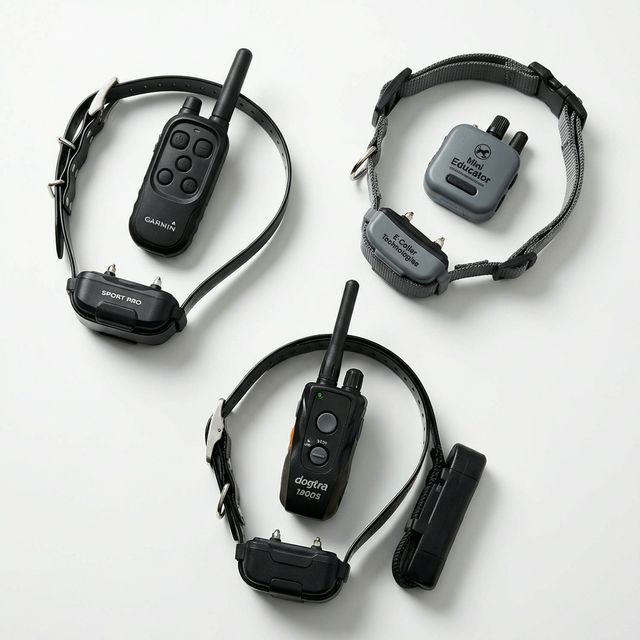
Top remote dog training collars from Educator, Dogtra, and Garmin compared by range, stimulation levels, and waterproofing.

Alex Corsa
Founder & Editor ·
📖 Table of Contents
Affiliate Disclosure: As an Amazon Associate, we earn from qualifying purchases. This comes at no extra cost to you and helps support our independent testing and reviews. We only recommend products we genuinely believe in.
The global dog training collar market hit $1.2 billion in 2024 and is projected to reach $2.5 billion by 2031 (Blue Ribbon K9, 2025). Remote training collars have changed significantly over the past decade. The old-school “shock collar” label doesn’t reflect what modern e-collars actually do. Current models offer precise stimulation levels ranging from barely perceptible taps to stronger corrections, along with vibration and tone-only modes.
Most professional trainers who use e-collars work exclusively at the lowest levels — the goal is communication, not punishment. But how do you know which one fits your dog? The three brands that dominate professional training circles are Educator (E-Collar Technologies), Dogtra, and Garmin — each with distinct strengths.
TL;DR: The Mini Educator ET-300 ($180-$220) is the best all-around training collar for most dogs, with 100 stimulation levels and a 1/2-mile range. For small dogs under 35 lbs, the Dogtra 200iQ ($130-$160) starts at lower stimulation levels. Budget pick: PetSpy P620 at $45-$60. Only about 2% of U.S. dog owners currently use e-collars (NIH, 2024).
Here’s a breakdown of the best options, who each one suits, and what to avoid.
Quick Comparison
| Collar | Best For | Range | Stim Levels | Waterproof | Price Range |
|---|---|---|---|---|---|
| Mini Educator ET-300 | Most dogs / beginners | 1/2 mile | 100 | IPX7 | $180-$220 |
| Educator EZ-900 | Easier remote handling | 1/2 mile | 100 | IPX7 | $200-$240 |
| Dogtra 200iQ | Small dogs / puppies | 1/4 mile | 100 | IP67 | $130-$160 |
| Dogtra 1900S | Large / stubborn dogs | 3/4 mile | 127 | IPX9K | $250-$300 |
| Garmin Delta SE | Beginners wanting simplicity | 1/2 mile | 10+vibrate | IPX7 | $150-$180 |
| Garmin Sport PRO | Hunters / working dogs | 3/4 mile | 10 | IPX7 | $200-$250 |
| SportDOG SportHunter 825X | Hunting / field work | 1/2 mile | 21 | IPX8 | $170-$210 |
| PetSpy P620 | Budget option | 650 yards | 16 | IPX6 | $45-$60 |
Best Overall: Mini Educator ET-300
The Mini Educator has earned its reputation as the default recommendation among professional trainers. It shows up more consistently in trainer forums, Reddit discussions, and professional training communities than any other collar.
What makes it stand out is the combination of precise low-level stimulation and reliability. The ET-300 offers 100 stimulation levels, and many trainers work exclusively between levels 5 and 15 — the lowest quarter of the range. At these levels, the sensation is closer to a gentle tap than anything resembling a shock. Dogs typically show awareness (ear flick, slight pause) without distress.
The remote is compact with a dial for stimulation level and dedicated buttons for momentary, continuous, and tone. The dial placement takes a few training sessions to get used to, but once it clicks, adjustments become intuitive even without looking at the remote.
Battery life is solid — about 50-70 hours between charges for the collar, and similar for the remote. The collar is waterproof (IPX7, submersible to 1 meter for 30 minutes), which covers rain, puddles, and most swimming.
Price: Around $180-$220 Range: 1/2 mile Best for: Pet owners and trainers working with medium to large dogs. The most recommended starting point for first-time e-collar users. Not ideal for: Very small dogs under 8 lbs (contact points may be too large) — see Dogtra 200iQ instead.
Best Remote Ergonomics: Educator EZ-900
The EZ-900 is Educator’s answer to the one common complaint about the Mini Educator: the remote dial can be overly sensitive, leading to accidental level changes in your pocket or when gripping it tightly.
The EZ-900 redesigns the remote with an ergonomically shaped body, a less sensitive dial with more defined clicks, and dedicated buttons that are harder to accidentally press. The collar receiver is identical to the ET-300. The stimulation feels the same, the waterproofing is the same, and the battery life is the same.
It’s essentially the same training tool with a better remote. If you’ve read Mini Educator reviews and seen complaints about the dial, the EZ-900 solves that problem.
Price: Around $200-$240 Range: 1/2 mile Best for: Trainers who want Educator quality with a more forgiving remote layout. Good for owners with large hands or those who pocket the remote during training.
Best for Small Dogs: Dogtra 200iQ
The Dogtra 200iQ is designed specifically for small dogs and puppies (generally under 35 lbs, though some trainers use it up to 50 lbs for sensitive breeds). The collar receiver is compact and lightweight enough that it sits comfortably on small necks without overwhelming the dog.
Stimulation starts at genuinely low levels — lower than what many full-sized e-collars can produce at their minimum. For a 15-pound dog or a sensitive breed like a Vizsla or Whippet, this matters. Full-sized collars at level 1 can still be more stimulation than a small or sensitive dog needs.
The remote features an improved dial with better grip and smart button placement designed to prevent accidental touches — a refinement from Dogtra’s earlier IQ Mini model.
Price: Around $130-$160 Range: 1/4 mile (about 400 yards) Best for: Dogs under 35 lbs, puppies in their first e-collar training, and sensitive breeds that react strongly to low stimulation. Not ideal for: Large breed training or work at extended distances.
Best for Stubborn Dogs: Dogtra 1900S
The Dogtra 1900S is the workhorse e-collar for large, high-drive, or genuinely stubborn dogs. It offers 127 stimulation levels with a “high power” output that exceeds what most other collars can deliver at maximum.
This additional power matters for specific situations: thick-coated breeds where the stimulation needs to penetrate more fur, dogs with high prey drive that tune out lower-level corrections when locked onto a squirrel, and working dogs in high-distraction field environments.
The collar is IPX9K waterproof — the highest waterproof rating in the consumer e-collar market, meaning it can withstand high-pressure, high-temperature water jets. It’s built for dogs that swim, hunt in marshes, and generally abuse equipment.
Price: Around $250-$300 Range: 3/4 mile Best for: German Shepherds, Malinois, hounds, and other large or high-drive breeds. Also a solid choice for hunting dogs that work in water. Not ideal for: Small dogs, sensitive breeds, or pet owners who don’t need the extra power range.
Best for Beginners: Garmin Delta SE
Garmin simplifies the e-collar experience with the Delta SE. Where other remotes have dials and multiple modes, the Delta SE gives you three buttons: momentary stimulation, continuous stimulation, and tone. A side switch cycles through 10 static stimulation levels plus a vibrate-only setting.
The simplicity is the point. For first-time e-collar users who find 100-level dials intimidating, the Delta SE removes decision paralysis. Pick a level, press a button. The collar’s loud beep function is also useful for dogs that are hard of hearing or for recall training at distance.
Garmin’s build quality is reliable — the same engineering behind their GPS devices shows in the collar construction. Battery life and waterproofing are comparable to Educator and Dogtra models.
Price: Around $150-$180 Range: 1/2 mile (about 880 yards) Best for: First-time e-collar users who want straightforward operation without a learning curve. Not ideal for: Experienced trainers who want fine-grained stimulation control.
Best for Hunting: Garmin Sport PRO
The Sport PRO is designed for field training and hunting. It adds bark limiter modes (useful for controlling unwanted barking in a hunting blind), expanded stimulation options, and a more ruggedized build compared to the Delta SE.
Garmin also offers the Alpha and PRO 550 Plus models with GPS tracking built in. If you need both a training collar and a tracking system for off-leash work in large areas, the GPS-integrated models replace two separate devices.
Price: Around $200-$250 (Sport PRO), $350-$500+ (GPS models) Range: 3/4 mile (Sport PRO) Best for: Hunters, working dog handlers, and anyone who trains in large open areas.
Best Budget: PetSpy P620
The PetSpy P620 offers usable e-collar functionality at about a third the price of the major brands. It provides 16 adjustable stimulation levels, vibration, and tone modes, with a 650-yard range and IPX6 waterproofing (rain-resistant but not submersible).
The tradeoff is build quality and longevity. PetSpy collars work fine for basic pet training needs, but they don’t match the precision, durability, or consistency of Educator or Dogtra at higher stimulation levels. The stimulation can feel less even compared to premium collars, and the remote ergonomics are basic.
For pet owners who want to try e-collar training before committing to a $200+ collar, it’s a reasonable starting point.
Price: Around $45-$60 Range: About 650 yards Best for: Pet owners on a budget who want to test e-collar training before investing in a premium model. Not ideal for: Professional training, hunting, or dogs that work in water regularly.
E-Collar Training Basics
An e-collar is a communication tool, not a punishment device. Despite the $1.2 billion market, the methodology hasn’t changed in 30 years. Here’s the fundamental approach used by most professional trainers:
Start With Known Commands
Only introduce an e-collar after your dog already understands the command you’re reinforcing. The dog should know “come,” “sit,” or “heel” through positive reinforcement first. The e-collar then becomes a way to communicate those commands at a distance.
Find the Working Level
Start at level 1 and increase one level at a time until your dog shows awareness — usually a slight ear flick, head turn, or pause. That’s your baseline working level. Most dogs’ working level falls between 5 and 20 on a 100-level collar.
Pair Stimulation With the Command
Say the command, then immediately apply stimulation at the working level. When the dog complies, release the stimulation and praise. The dog learns that performing the command makes the stimulation stop — and that performing it before stimulation starts avoids it entirely.
Never Use an E-Collar for Punishment
E-collars used reactively — zapping a dog after it does something wrong — create fear and confusion. The collar should only reinforce commands the dog already understands.
What to Avoid
No-name brands under $30. These often have inconsistent stimulation that jumps unpredictably between levels, poor waterproofing that fails after the first rain, and customer support that doesn’t exist.
Bark-activated-only collars. These aren’t the same category as remote training collars. They activate automatically based on barking, which means the dog has no way to understand or anticipate the correction. See our bark collar guide for dedicated anti-barking devices if that’s what you need.
Prong or choke collar combinations. Some sellers pair e-collars with prong collars. This is double-correction and most professional trainers strongly advise against it. Use one or the other, not both.
Frequently Asked Questions
Are e-collars safe for dogs?
Modern e-collars used correctly at appropriate levels are considered safe by most veterinary behaviorists. A study of over 1,000 adolescent dog owners found only 2% reported using e-collars (NIH, 2024). The stimulation at working levels (typically 5-20 on a 100-level scale) is comparable to a TENS unit used in human physical therapy. Start low, find the working level, and never use the collar to punish.
At what age can you start using an e-collar?
Most trainers recommend waiting until 5-6 months minimum. The dog needs to understand basic obedience commands first — the e-collar reinforces known commands, it doesn’t teach new ones. Starting too young, before the dog has the foundation, leads to confusion.
How tight should a training collar fit?
The contact points should touch the skin consistently but not dig in. You should be able to fit one finger between the collar and the dog’s neck. If the collar spins freely, it’s too loose and won’t make consistent contact. Check the fit every few hours during initial use, as the collar can shift.
Can you use an e-collar in the rain?
Most quality e-collars (Educator, Dogtra, Garmin) are rated IPX7 or higher, meaning they handle rain and water exposure. The Dogtra 1900S is rated IPX9K, which handles submersion and high-pressure water. Check your specific model’s rating before extended water exposure.
Do you need a professional trainer to use an e-collar?
Not necessarily, but working with a trainer for the first few sessions is highly recommended. The learning curve isn’t about the collar hardware — it’s about timing and methodology. A trainer can help you find the correct working level for your dog and show you proper command pairing in 1-2 sessions.
You Might Also Like
Alex Corsa
Founder & Editor
Alex Corsa has owned and fostered dogs for over 12 years, with hands-on experience caring for everything from senior mastiffs to reactive rescues and brachycephalic breeds. He started DogSupplyFinder after spending two frustrating years testing gear that failed, broke, or simply didn't work as advertised. Every recommendation on this site has been vetted against real-world use — not affiliate commission rates. Alex cross-references veterinary guidelines and AAFCO regulations for all food and health content.
Dog Tips, Deals & Gear Guides
Expert buying guides, breed-specific product picks, and honest gear reviews. Plus our free New Puppy Checklist for subscribers.
📬 No spam, ever. Unsubscribe anytime. · Get the free puppy checklist