How to Teach Your Dog a Reliable Recall (Come Command)
A rock-solid recall is the most important command your dog can learn. Step-by-step protocol that works even with distractions, for puppies and adult dogs.

Alex Corsa
Founder & Editor ·
📖 Table of Contents
Affiliate Disclosure: As an Amazon Associate, we earn from qualifying purchases. This comes at no extra cost to you and helps support our independent testing and reviews. We only recommend products we genuinely believe in.
The recall — “come” — is the single most useful thing your dog will ever learn. It is also the training most owners rush through, skip steps on, or accidentally poison early by using it to end fun. A dog with a reliable recall can have more freedom. A dog without one cannot.
Here is the protocol that works, from first introduction to proofing under real-world distraction.
TL;DR: Start with a high-value cue word (“come” or a whistle), never punish your dog for responding to it, use extreme reinforcement at first, and add distractions only after the behavior is solid in low-distraction environments. The whole process takes 4–8 weeks done consistently.
Why Most Recalls Fail
Before the protocol, understand the failure modes:
The “come = end of fun” problem. If you always call your dog’s name when it’s time to leave the dog park, leash up, or go inside, your dog learns that “come” predicts bad things. They start ignoring the command in high-arousal situations.
Repeating the cue. “Biscuit, come. Biscuit, COME. BISCUIT! COME!” teaches the dog that you mean it on the fifth repetition, not the first. Call once, then reinforce the word — don’t increase volume.
Punishing the dog when it finally comes. Even if your dog took five minutes and you’re furious, when they finally reach you, the only correct response is enthusiastic praise. Punishing them teaches them that coming to you is unsafe.
Using the cue before it’s reliable. If you call your dog in a situation where they ignore the command, you’ve just trained that ignoring is okay. Keep your expectations calibrated to what your dog can actually do in that environment.
Equipment You Need
For recall training, equipment matters more than most commands:
- A long line (20–30 feet): Essential for proofing in outdoor spaces before the recall is reliable off-leash. Not a retractable leash — a fixed-length line that gives you management without creating tension. See our best long-line leash picks if you need one.
- High-value treats: The reward for recall should be better than anything in the environment. If you’re training near squirrels, chicken works better than kibble. Freeze-dried liver, cheese, hot dogs, or rotisserie chicken are all appropriate.
- A treat pouch: You need to reload the cue within 2–3 seconds of the dog reaching you. Fumbling in your pocket slows the reinforcement timing.
- Optional — a whistle: A whistle signal is consistent (it always sounds the same regardless of your emotional state) and carries further than a voice command. Useful for advanced recall, especially for hunting dogs or dogs in large open spaces.
Phase 1: Charging the Cue (Days 1–7)
Before your dog can reliably come when called, they need to have a strong positive emotional response to the sound of the cue word.
The repetition drill:
- In a small, quiet room with no distractions, say your cue word once in a happy voice
- The moment the dog looks at you or takes any step toward you, throw or hand them several high-value treats in a row (not one — a “jackpot” of 3–5 treats)
- Let them sniff the floor, wander, or look away again
- Repeat
Do 10–15 repetitions per session. Three sessions a day. By day 3–4, your dog should be snapping their head toward you the moment they hear the cue — before the treats even appear. That reflexive head-turn is what you are building.
Never call the cue when your dog can’t possibly succeed in the first week. If they’re distracted, use movement (run away from them — dogs chase) or make a noise instead. Save the cue for when you know they’ll respond.
Phase 2: Reinforcing the Real Recall (Week 2)
Now practice actual recalls with distance, in the same low-distraction environment.
The “race to you” game:
- Have your dog in a sit or standing a few feet away
- Back up a few steps while saying the cue once
- When they reach you, reward them with an enthusiastic jackpot
- Release them with “okay” or “free” so recall doesn’t always equal the end of movement
Principles for this phase:
- Always reward within 2 seconds of them reaching your hand — timing is everything in reinforcement
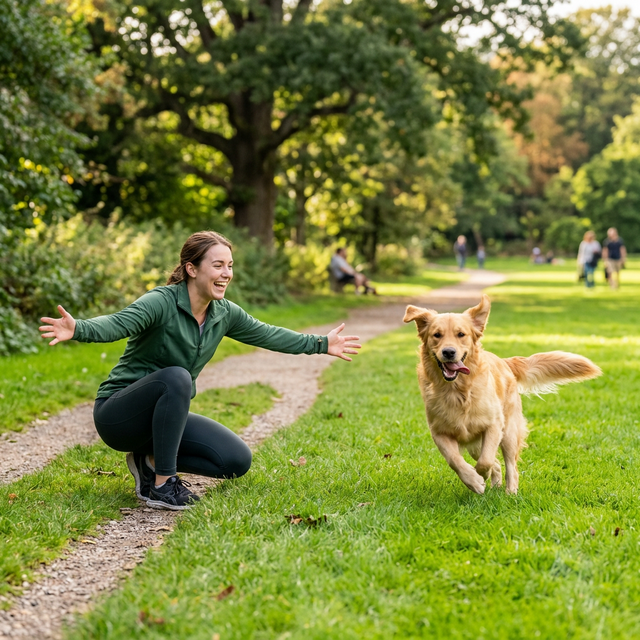
- Make it physically fun — crouch down, open arms, run backward. Energy is contagious
- Vary the reward — sometimes 5 treats, sometimes a toy, sometimes a play session. Variable reinforcement builds stronger behavior than fixed
- Never call the cue and then walk toward the dog — you go to them if they don’t come; calling once and waiting teaches that the command means “you wait for them”
Run this phase for 5–7 days at 10-repetition sessions.
Phase 3: Adding the Long Line (Weeks 2–4)
Move training to the backyard or a quiet outdoor space. Attach the long line to a back-clip harness (not a regular collar — the line can produce a sharp jerk if the dog hits the end).
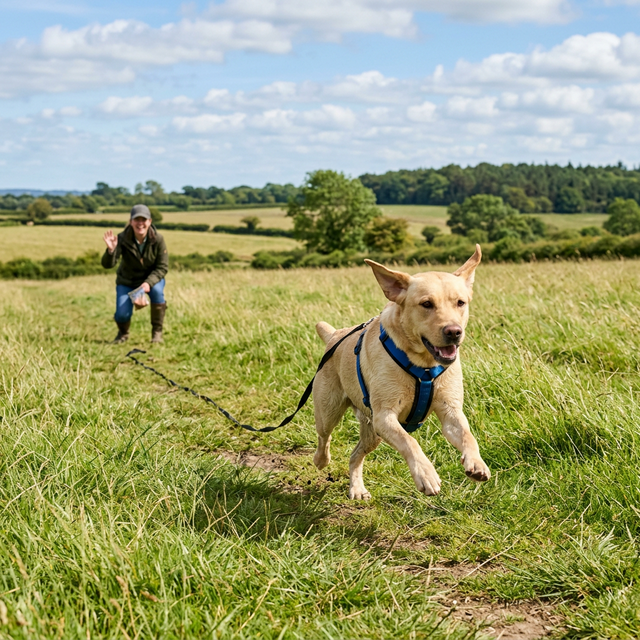 The long line lets you practice recall in real outdoor environments with a safety net — the dog can’t rewarded by the environment for ignoring you.
With the long line:
- Let your dog sniff and move around with the line trailing
- Call the cue once when they’re 15–20 feet away and facing away from you
- If they don’t respond within 2 seconds, use the line to gently help them toward you (don’t yank — start moving yourself backward while collecting the line)
- Reward massively when they reach you
The long line’s purpose is management, not punishment — it prevents the dog from being rewarded by the environment for ignoring you, and gives you a safety net as you increase distance.
Increase distance gradually over the first week: 15 feet → 25 feet → 30 feet. Work the long line for two full weeks before considering off-leash recalls.
Phase 4: Proofing with Distractions (Weeks 4–8)
This is where most owners rush and break the behavior. The rule: only increase one variable at a time.
Variables you will add sequentially:
- Distance (already started in Phase 3)
- Low distractions (empty park, light foot traffic)
- Moderate distractions (other dogs visible but not close)
- High distractions (dog park, off-leash field with other dogs running)
For each new distraction level, temporarily decrease distance. If you’re going from the backyard to a park with other dogs, go back to calling your dog at 10 feet first. Let them succeed at the easier version before extending.
Signs the distraction is too high:
- Your dog glances at you and then looks away
- They take a few steps and then get sucked back toward the distraction
- They come, but slowly and with a curved path
If you see these, you’re above threshold. Reduce to the previous distraction level for another week.
The Recall Emergency Protocol
Different from the trained recall for daily use, the “emergency recall” is a separate cue (different word or a whistle) charged with the highest possible reward — something the dog never gets in daily life.
To build it:
- Choose a new cue — “HERE!” or “COME HERE!” or three short whistle blasts
- Once per week, use this cue and reward with the jackpot of jackpots (rotisserie chicken, hot dogs, something extraordinary)
- Never use this cue casually — keep it sacred so the dog never becomes habituated to it
The emergency recall is what you use when the dog is running toward traffic and you need an override. Because it’s rarely used and always paired with over-the-top reward, it stays fresh.
What to Do When Your Dog Doesn’t Come
If you call once and your dog doesn’t come:
- Do not repeat the cue
- Run away from them (movement triggers chase instinct)
- Make a novel noise — squeak a toy, rustling a treat bag
- Crouch down and open your arms
- If using a long line, collect it slowly while moving backward
When they reach you, reward them even though they were slow. Coming late is still coming.
Gear for Recall Training
- Long biothane leash (20–30 ft): Waterproof, doesn’t absorb mud, easy to clean. See our leash recommendations
- Front-clip or back-clip harness for long-line work: Protects the neck from any line tension. Our no-pull harness guide covers options at every price point
- High-quality treat pouch: Hands-free carry, magnetic closure. Enables the 2-second reward timing that makes a difference
Frequently Asked Questions
How long does recall training take?
For a dog with no prior history of ignoring the recall: 4–8 weeks of consistent daily practice to build reliability in moderate distraction environments. High distraction proofing (off-leash dog parks, near wildlife) can take 3–6 months. There is no shortcut.
My dog is great in the house but ignores me outside. Normal?
Very normal. The backyard and park are not the same environment to your dog. They have completely separate reinforcement histories in each location. You need to train in each new environment specifically, starting at the easy end of the distraction spectrum.
Can I teach recall to an older dog?
Yes. Adult dogs absolutely learn recall. The process is the same, but you may need to work harder to undo existing recall-avoidance behavior if the dog has learned that ignoring “come” is safe.
Should I use an e-collar for recall?
Force-free trainers widely recommend against e-collars for recall because a poorly timed correction when the dog is coming toward you teaches that approaching you causes pain. This creates the opposite of what you want. The positive reinforcement protocol in this guide works for the vast majority of dogs without aversive tools.
You Might Also Like
Alex Corsa
Founder & Editor
Alex Corsa has owned and fostered dogs for over 12 years, with hands-on experience caring for everything from senior mastiffs to reactive rescues and brachycephalic breeds. He started DogSupplyFinder after spending two frustrating years testing gear that failed, broke, or simply didn't work as advertised. Every recommendation on this site has been vetted against real-world use — not affiliate commission rates. Alex cross-references veterinary guidelines and AAFCO regulations for all food and health content.
Dog Tips, Deals & Gear Guides
Expert buying guides, breed-specific product picks, and honest gear reviews. Plus our free New Puppy Checklist for subscribers.
📬 No spam, ever. Unsubscribe anytime. · Get the free puppy checklist