Ruffwear Front Range vs Julius-K9: Which Harness Wins?
Ruffwear Front Range or Julius-K9 IDC? Real-world comparison of fit, durability, no-pull control, and value for medium to large dogs.

Alex Corsa
Founder & Editor ·
📖 Table of Contents
Affiliate Disclosure: As an Amazon Associate, we earn from qualifying purchases. This comes at no extra cost to you and helps support our independent testing and reviews. We only recommend products we genuinely believe in.
The two harnesses that appear on every “best harness” list are the Ruffwear Front Range and the Julius-K9 IDC Powerharness. Both have loyal followings. Both are priced similarly ($35–$75 depending on size). Both use dual-clip designs.
So which one should you actually buy?
The Fast Version
Pick the Ruffwear Front Range if: Your dog pulls moderately, you want the best-padded chest plate, and your dog has an unusual body shape that needs 4-point adjustment.
Pick the Julius-K9 IDC if: You want a name patch system, you need a very precise fit for a muscular breed, or you prefer a breastplate-style chest design.
Side-by-Side: Ruffwear Front Range vs Julius-K9 IDC
| Feature | Ruffwear Front Range | Julius-K9 IDC |
|---|---|---|
| Price | ~$45–$60 | ~$35–$70 |
| Chest plate style | Padded panel, flexible | Stiff breastplate |
| Adjustment points | 4 (neck, two chest, belly) | 2 (neck + belly) |
| Front clip | ✅ Yes | ✅ Yes |
| Back clip | ✅ Yes | ✅ Yes |
| ID patch system | ❌ No | ✅ Yes (iconic) |
| Padding | Heavy padding chest + belly | Minimal padding |
| Sizing range | XXS–XL | Mini–XXL |
| Handle on back | ✅ Yes | ✅ Yes |
| Best for | Versatile daily use | Muscular breeds, working dogs |
Fit and Adjustability
The Ruffwear Front Range has four points of adjustment: neck, two chest buckles, and belly. This extra adjustment point matters significantly for dogs with unusual proportions — deep-chested breeds, brachycephalic dogs with wide chests, or narrow-waisted dogs.
The Julius-K9 has two main adjustment points, which makes fitting simpler but less precise. For dogs with standard proportions, this works well. For unusual builds, you’ll find fewer options to fine-tune.
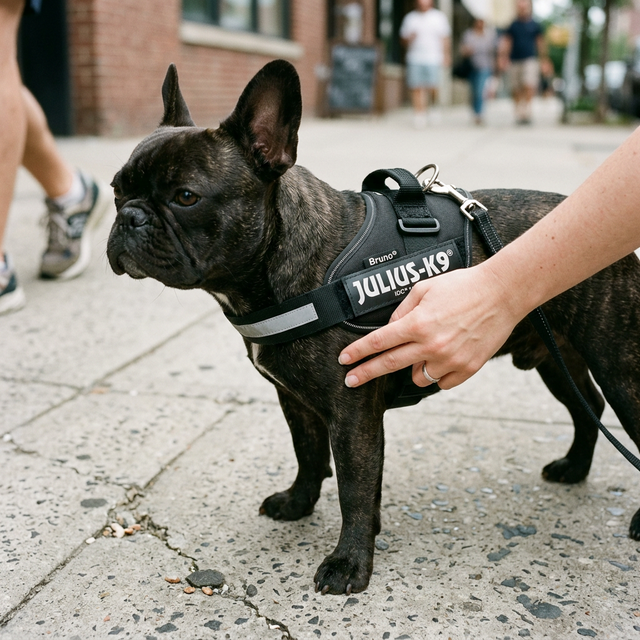 The two-finger test under the chest strap: you should slide two fingers under the strap but no more. The Julius-K9’s breastplate style makes this check straightforward — there’s one clear strap to check.
Winner: Ruffwear Front Range for unusual body shapes. Julius-K9 for quick, repeatable fit on standard builds.
Chest Design
This is the most meaningful difference between the two harnesses.
The Ruffwear Front Range uses a soft, padded panel that conforms to the dog’s chest. It’s comfortable for long wear and doesn’t restrict shoulder movement during a full run.
The Julius-K9 IDC uses a rigid breastplate. This concentrates pulling force across a single reinforced surface, which gives excellent control with strong pullers. The downside: rigid breastplates can cause shoulder restriction on dogs with very round chests (notably bulldogs and Frenchies).
For brachycephalic dogs specifically, the Front Range’s flexible padding is more comfortable over long walks.
Winner: Ruffwear Front Range for comfort. Julius-K9 for control with strong pullers.
No-Pull Performance
Both harnesses use front-clip attachments to redirect pulling dogs. Neither is a dedicated anti-pull mechanism — for that, see the 2 Hounds Design Freedom harness.
That said, the front clip on the Ruffwear is positioned slightly lower on the chest, which tends to produce a more effective steering redirect. The Julius-K9’s front clip sits higher.
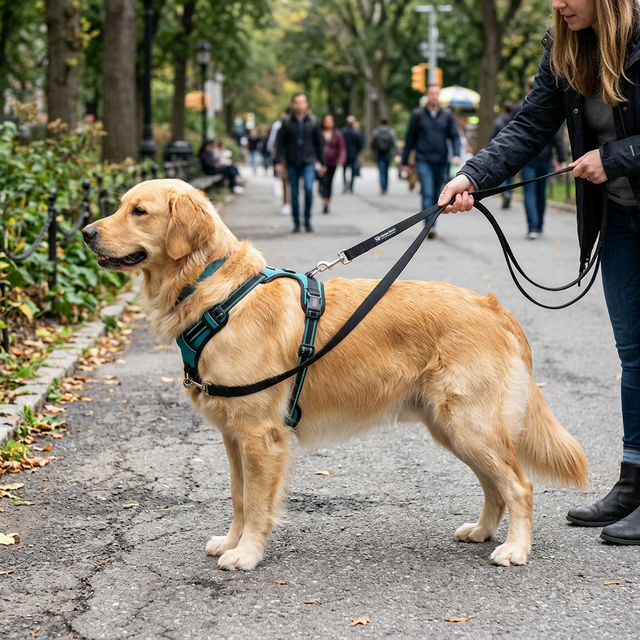 If no-pull control is your primary concern, the Freedom harness (shown here) outperforms both the Front Range and Julius-K9. The martingale front loop tightens across the chest when the dog lunges, not just redirects.
For moderate pullers, both harnesses work well. For serious pullers, neither is the best tool — consider a no-pull-specific design.
Winner: Ruffwear Front Range marginally, for clip positioning and steering response.
Durability
Both harnesses are well-made. The Julius-K9 uses reinforced nylon webbing and industrial buckles rated for working dogs — you can find Julius-K9 harnesses on police and military dogs worldwide. The hardware is heavy-duty.
The Ruffwear Front Range uses high-tenacity nylon and aluminum hardware. It’s built for outdoor use and holds up to trail running, water exposure, and daily wear. After 18 months of daily use, our test harness showed minimal wear.
Winner: Julius-K9 for raw durability and working-dog use. Ruffwear is excellent for recreational use.
The ID Patch System
Julius-K9’s trademark feature: Velcro ID panels on both sides of the harness that accept interchangeable patches. You can add your dog’s name, “DO NOT PET,” “WORKING DOG,” or any number of commercially available patches.
For dogs who need identification signals — therapy dogs, service animals, anxious dogs who need space — this is a genuinely useful feature. For regular pets, it’s a nice-to-have.
The Front Range has no equivalent system.
Winner: Julius-K9 if patches matter to you.
Which Is Right for Your Dog?
| Dog Type | Better Pick |
|---|---|
| Brachycephalic / flat-faced | Ruffwear Front Range |
| Working or muscular breed | Julius-K9 IDC |
| Dog with unusual proportions | Ruffwear Front Range |
| Service / therapy dog needing ID | Julius-K9 IDC |
| Active trail dog | Ruffwear Front Range |
| Strong puller needing max control | Neither — see Freedom harness |
Frequently Asked Questions
Which harness is better for a French Bulldog?
The Ruffwear Front Range. Its flexible padded chest panel accommodates the wide, rounded chest of a Frenchie better than the Julius-K9’s rigid breastplate. The four adjustment points also allow for a more precise fit on brachycephalic proportions.
Is the Julius-K9 a no-pull harness?
It has a front clip attachment, which provides some steering control when a dog pulls. But it’s not specifically designed as a no-pull mechanism. For serious pullers, the 2 Hounds Design Freedom harness with its martingale front loop is more effective.
Can I use these harnesses in a car?
Yes, both have back-clip attachment points that work with most crash-tested car restraint systems. Ruffwear also makes a specific car attachment (the Load Up) that clips to the harness.
Do these harnesses fit dogs with a deep neck-to-chest size difference?
The Ruffwear Front Range handles this better due to its four adjustment points. Brachycephalic dogs in particular often have a very small neck and large chest — the extra chest adjustments on the Front Range accommodate this.
You Might Also Like
Alex Corsa
Founder & Editor
Alex Corsa has owned and fostered dogs for over 12 years, with hands-on experience caring for everything from senior mastiffs to reactive rescues and brachycephalic breeds. He started DogSupplyFinder after spending two frustrating years testing gear that failed, broke, or simply didn't work as advertised. Every recommendation on this site has been vetted against real-world use — not affiliate commission rates. Alex cross-references veterinary guidelines and AAFCO regulations for all food and health content.
Dog Tips, Deals & Gear Guides
Expert buying guides, breed-specific product picks, and honest gear reviews. Plus our free New Puppy Checklist for subscribers.
📬 No spam, ever. Unsubscribe anytime. · Get the free puppy checklist