Wet vs Dry Food for French Bulldogs: Which Is Better?
Wet vs dry dog food for French Bulldogs: digestibility, gas, dental health, cost, and which format works best for Frenchies with sensitive stomachs.

DogSupplyFinder Research Team
Product Research ·
📖 Table of Contents
Affiliate Disclosure: As an Amazon Associate, we earn from qualifying purchases. This comes at no extra cost to you and helps support our independent testing and reviews. We only recommend products we genuinely believe in.
French Bulldog owners debate this constantly, and both options have genuine advantages. The honest answer isn’t “one is better”, it’s “the right choice depends on your specific dog’s issues.”
Here’s the breakdown without the marketing spin.
The Fast Version
**Dry kibble wins on: Cost, dental health, portion control, convenience, less gas from fermentation in most dogs.
Wet food wins on: Hydration, palatability for picky eaters, easier chewing, and calorie density per cup.
Best approach for most Frenchies: Quality dry kibble as the base, supplemented with a spoonful of wet food if palatability is an issue. Or a rotation diet that includes both.
The French Bulldog-Specific Considerations
Before comparing formats generically, the breed has specific issues that change the calculation:
-
Gas and digestive sensitivity: Frenchies ferment poorly-digestible ingredients aggressively. The question is which format reduces this, and the answer depends more on ingredient quality than wet vs. dry.
-
Brachycephalic jaw: Their underbite and short jaw make large kibble hard to chew. They often swallow pieces whole, which increases gas from gulped air. Wet food eliminates this.
-
Weight gain tendency: Frenchies gain weight easily. Wet food has high moisture content (75–85% water), which makes volumetric portion control misleading. Owners often underfeed or overfeed wet food without realizing it.
-
Sensitive skin: Many Frenchies have skin issues tied to food ingredients. Format matters less here than the specific protein source.
Dry Food (Kibble)
Advantages for Frenchies
Cost: Quality wet food costs 3–5x more per calorie than dry. A 30-lb bag of Hill’s Science Diet (~$95) provides roughly 90 days of food for a 25-lb Frenchie. The equivalent in wet food costs $200–300 for the same period.
Dental health: The mechanical scrubbing action of chewing kibble reduces tartar buildup. Frenchies are prone to dental problems partly because their crowded teeth trap food. Kibble provides mild but consistent dental benefit wet food does not.
Portion control: Measuring by cup or weight is straightforward with kibble. With wet food, you’re measuring by the can or container, and caloric density varies significantly.
Gas: Some Frenchies actually produce less gas on quality kibble than on wet food. The fermentation hypothesis: cheaper wet foods use high-moisture ingredients that include more fermentable carbohydrates. This isn’t universal, but it’s a real pattern.
Disadvantages
Chewing difficulty: The Frenchie underbite means they physically can’t chew standard-size kibble efficiently. Small or breed-specific kibble (Royal Canin’s French Bulldog formula has a specific trapezoid shape for this) can minimize swallowing whole, but it’s still an issue.
Hydration:** Dry kibble is ~10% moisture. Dogs who eat exclusively dry often drink enough water to compensate, but Frenchies who don’t drink well can end up chronically mildly dehydrated.
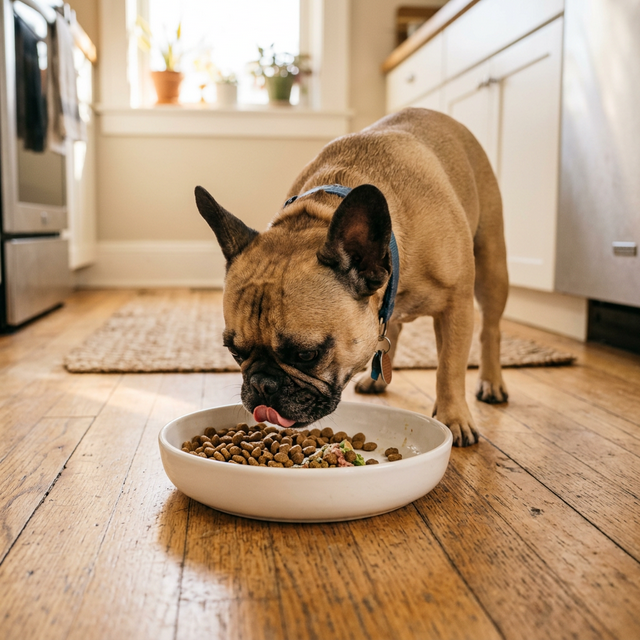
Bowl shape affects how a Frenchie eats regardless of food format. A shallow, wide bowl reduces neck compression for both kibble and wet food. Deep narrow bowls cause Frenchies to push food around with their nose.
Wet Food (Canned/Pouched)
Advantages for Frenchies
**Palatability: Picky Frenchies who reject multiple dry foods often accept wet food without hesitation. The higher fat and moisture content make it smell and taste more appealing.
Hydration: 75–85% moisture content means a Frenchie eating wet food is passively consuming significant water. This can help dogs prone to urinary issues or those who simply don’t drink enough.
Easier chewing: No chewing required. For senior Frenchies with dental problems or post-oral-surgery recovery, wet food is the only practical option.
Higher protein density by dry matter: Wet food often has higher protein percentages when you account for moisture removal, though this can be misleading (see below).
Disadvantages
Cost: Significantly more expensive per calorie. Budget is a real factor here.
Dental health: No mechanical scrubbing. Wet food residue is stickier than dry, which can accelerate tartar buildup in a breed already prone to dental crowding. Wet food owners should brush more frequently or use dental supplements.
Gas in some dogs: The counterintuitive case. High-moisture ingredients in cheap wet food ferment aggressively in the colon. If your Frenchie’s gas gets worse on wet food, this is likely why.
Portion confusion: A 3.5 oz can of wet food has roughly 80–110 calories. A 30 lb Frenchie needs about 700 calories/day. That’s 6–8 cans per day, which most owners would never estimate without calculating it.
Mixed Feeding: The Best of Both
Most veterinary nutritionists don’t recommend exclusive wet or exclusive dry, they recommend using both in a way that works for the individual dog.
Common approach: 70–80% dry kibble as the base (providing dental benefit and cost control) plus 1–2 tablespoons of wet food as a topper. This significantly improves palatability while keeping costs manageable and maintaining the dental health benefit of kibble.
Rotation feeding: Alternating between wet and dry meals (morning dry, evening wet). Frenchies prone to boredom with food often do better with rotation.
Which to Choose Based on Your Frenchie’s Issue
| Problem | Better Format |
|---|---|
| Picky eater, refuses kibble | Wet food or wet topper |
| Excess gas / digestive issues | Try quality dry kibble first; some dogs improve |
| Dental problems / tooth loss | Wet food |
| Weight management needed | Dry kibble (easier to measure) |
| Senior dog (10+) | Mix or wet only |
| Doesn’t drink enough water | Wet or mixed |
| Budget constraint | Dry kibble |
| Strong chewer, no health issues | Dry kibble |
Specific Product Picks
Best dry for Frenchie digestion: See our Hill’s vs Royal Canin comparison for the two most vet-recommended options compared head-to-head.
Best for picky eaters: Royal Canin French Bulldog Adult (wet version available in the same formulation, useful for transitioning picky dogs who accept Royal Canin wet but not dry).
Best overall food guide:** Best Dog Food for French Bulldogs with all format options covered.
Frequently Asked Questions
Can I switch between wet and dry suddenly?
No, always transition over 7–10 days regardless of direction. Sudden food changes cause digestive upset in Frenchies. Mix increasing proportions of new food into the old food over that period.
My Frenchie vomits after eating dry kibble. Should I switch to wet?
First check the bowl and eating pace, Frenchies often vomit after eating too fast. Try a slow feeder bowl or a puzzle bowl before changing food formats. If vomiting continues with a slow feeder, consult your vet — regurgitation can indicate megaesophagus or a hiatal hernia, both of which occur at higher rates in bulldogs and Frenchies.
Is grain-free wet food better for Frenchies?
Not necessarily. See our dry food discussion on grain-free — the same FDA concerns apply to wet food. Unless your Frenchie has a confirmed grain allergy (tested by your vet), stick to formulas with quality digestible grains.
How do I know how much wet food to feed?
Calculate calories, not volume. A 25-lb moderately active adult Frenchie needs roughly 600–700 calories per day. Check the caloric content on the can label (usually listed as kcal per can or per 100g) and calculate from there. Don’t use the feeding chart on the label as a precise guide — they tend to overestimate.
You Might Also Like
- Best Dog Food for French Bulldogs (Full Guide)
- Hill’s Science Diet vs Royal Canin for French Bulldogs
- Best Dog Bowls for Flat-Faced Breeds
- Best Slow Feeders for Brachycephalic Dogs
We evaluate pet products independently. To learn more about our editorial standards, read our Editorial Policy.
DogSupplyFinder Research Team
Product Research
Our research team analyzes ingredient lists, AAFCO feeding standards, safety specifications, and thousands of verified owner reviews, with particular attention to breed-specific needs such as brachycephalic breeds and dogs with dietary sensitivities. Evaluations prioritize safety specs, third-party certifications, and manufacturer quality controls over marketing language.
Dog Tips, Deals & Gear Guides
Expert buying guides, breed-specific product picks, and honest gear reviews. Plus our free New Puppy Checklist for subscribers.
📬 No spam, ever. Unsubscribe anytime. · Get the free puppy checklist