Best GPS Wireless Dog Fences: Halo 3 vs SpotOn vs Garmin
A complete comparison of the best GPS wireless dog fences in 2026, comparing Halo 3 vs SpotOn vs Garmin for boundary accuracy, tracking, and pricing.

DogSupplyFinder Research Team
Product Research ·
📖 Table of Contents
The best GPS wireless dog fence for most dog owners in 2026 is the Halo 3 Wireless Dog Fence due to its dual-frequency GPS accuracy, cellular real-time tracking, intuitive app-controlled custom boundaries, and structured training programs. If you are still deciding among GPS, RF wireless, and in-ground wire, start with the dog fence buying guide. RF and hybrid collars live on wireless fences compared. Yard hazards beyond the collar are dog-proofing your yard. A tracker that does not contain is GPS trackers. The cluster is the blog hub. Affiliate context is how we make money.
Listing check (GPS fence collar): match the current module name (Halo 3 vs an older Halo, SpotOn vs a bark-only or RF “wireless” collar) and the stated minimum dog weight. Confirm the Amazon offer is the GPS collar / kit, not a random nylon strap in the same photo. Read the subscription fine print on the brand site — marketplace titles often omit the LTE plan that makes live tracking work. Prefer New; used collars arrive with depleted batteries and accounts still tied to a previous owner. Check Amazon’s return window — a collar that drifts 10 feet on a small lot is a common return. Recommendations come from specs and owner reports, not an in-house lab.
Who this page is for — and when to skip
Use this ranking if: you have about a half-acre or more, will walk a flagged boundary for two weeks, and want a portable geofence instead of buried wire. Skip GPS containment if: the yard is under ~0.5 acre — satellite drift will beep on the porch. Skip Halo-style cellular if: you will not pay the monthly plan or you live where LTE is a rumor. Skip SpotOn if: you only need a simple suburban rectangle and do not want the premium walk-to-map kit. Skip this page if: you want an RF circle around a transmitter — that is wireless RF fences, not GPS. Skip buying a shock-capable collar at all if: a physical fence plus a GPS tracker already covers escape risk, or the dog bolts through correction. Skip a containment collar as a substitute for a walk — a geofence is a boundary, not enrichment.
| Situation | Buy | Skip |
|---|---|---|
| 1–3 acre suburban lot, will train 14 days | Halo 3 + flags + leash work | An untrained collar on day one |
| Farm / irregular pond edge | SpotOn walk-to-map | A circular RF transmitter |
| Off-grid, no LTE | Garmin-style base station | A cellular-only SKU |
| Townhouse patio, 0.2 acre | Physical fence or in-ground wire | Any GPS geofence |
| Dog already ignores static | A real fence + tracker | A higher correction number |
Desk note: “wireless fence” on Amazon mixes RF circles, Wi-Fi bases, and GPS collars. Satellite vs transmitter in the spec table is the buying fact.
Executive Summary
- Top Performers: Halo 3, SpotOn, and Garmin represent the pinnacle of modern GPS wireless dog containment technology.
- Boundary Precision: SpotOn leads in boundary creation flexibility (custom walk-to-map boundaries), while Halo 3 is preferred for standard acreage mapping and user-friendly setup.
- Affordability: Halo 3 offers the best price-to-performance ratio, while SpotOn is a premium, subscription-optional investment for larger properties.
- Safety Training: Successful GPS containment requires completing the structured collar training program with your dog before relying on boundary alerts.
What is a GPS Wireless Dog Fence and How Does Feline/Canine Containment Work?
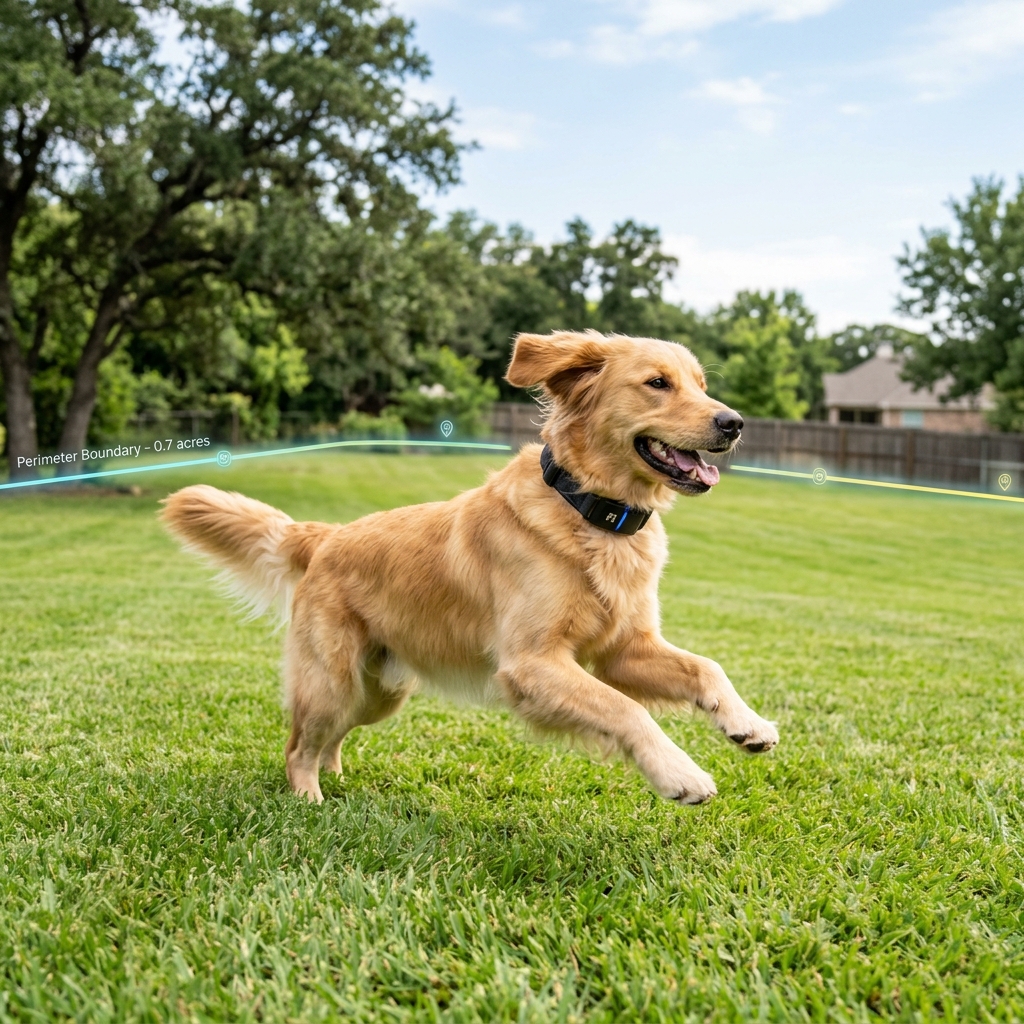
Unlike traditional wired underground fences, which require burying physical wire around your property lines, GPS wireless dog fences use satellite coordinates to create a virtual boundary (or geofence). The system consists of a single GPS-enabled collar worn by the dog and a connected smartphone app.
When you define your boundary lines in the app, the coordinates are synced directly to the collar. The collar constantly tracks your dog’s location relative to this boundary using GPS satellites. If your dog approaches the boundary, the collar issues a warning tone or vibration, followed by a correction (such as a static stimulus) if they attempt to cross it. Because the boundary is stored locally on the collar, the containment works anywhere, even if the collar loses connection to your phone.
Why is GPS Containment Replacing Traditional Wired Underground Fences?
Traditional wired fences have several distinct drawbacks: they are expensive to install, the physical wire can break during yard work (requiring tedious troubleshooting), and you cannot take the boundary with you when you travel.
GPS wireless fences solve all of these problems. You can set up your boundary in minutes by drawing it on a map inside your smartphone app or walking the perimeter with the collar. You can create multiple boundaries for different locations (like your home, a vacation cottage, or a campsite) and switch between them instantly. There are no physical wires to break, and the boundary size can expand from a fraction of an acre to thousands of acres depending on the model.
Halo 3 vs SpotOn: How Do the Top Feline/Canine Containment Collars Compare?
Halo 3 and SpotOn are the two most popular GPS fences on the market, but they target different use cases:
- Halo 3 (Best Value & Training): Co-developed by dog behaviorist Cesar Millan, Halo 3 is designed for standard yards and active training. It uses a dual-frequency GPS chip that reduces signal drift in areas with heavy tree cover. It requires a cellular plan to operate, but offers the best daily activity tracking and structured in-app training courses.
- SpotOn (Best for Large, Custom Acreage): SpotOn is the premium choice for large properties and farms. It allows you to create custom-shaped boundaries by walking the perimeter and does not require a subscription for basic containment. It uses a highly sensitive GPS antenna that tracks multiple satellite constellations simultaneously for superior boundary stability.
On the listing, match the current Halo 3 collar (not Halo 2+ leftover photos) and whether the box is collar-only vs a training kit. Confirm the weight band and that the brand’s cellular plan is priced on the brand site the same week. Skip Halo if you refuse a subscription. Match SpotOn to the walk-to-map GPS collar, not an RF “Spot” or bark collar in search results. Skip SpotOn on a tiny lot — you are paying for acreage mapping you cannot use. Garmin Inbounds is a base-station product; do not buy a random Garmin sport collar from the same search page.
What is the Cost of GPS Wireless Dog Fences in 2026?
GPS fences are significant investments, but they are often cheaper than paying a professional to trench and install a physical wired fence.
- Halo 3 Collar: Costs approximately $600 to $700 upfront, plus a mandatory subscription starting at $5.99 per month for cellular GPS connectivity.
- SpotOn Collar: Costs approximately $1,000 to $1,300 upfront. It operates containment without a subscription, but optional cellular tracking plans cost around $9.99 per month.
- Garmin Delta Inbounds: Costs approximately $800 to $900 upfront, using a dedicated base station instead of cellular connections, making it ideal for extremely remote off-grid locations.
How to Create and Sync a Virtual Boundary Safely?
Creating a boundary requires walking the perimeter or drawing it on the app map:
- With SpotOn: You walk the physical boundary line with the collar in hand. The collar drops GPS breadcrumbs along your path to map the boundary exactly, making it perfect for matching fence lines or avoiding natural obstacles like ponds.
- With Halo 3: You open the app map, select your property, and draw the boundary line with your finger. This is incredibly fast and convenient but requires clear satellite map views of your yard.
Once saved, the boundary is sent to the collar over Bluetooth or cellular networks. The collar stores the data locally, ensuring safety even if cell signals drop.
What Training Protocol is Required for GPS Dog Fences?
You cannot put the collar on your dog and expect them to understand the boundary immediately. You must complete a structured training phase to prevent fear or confusion:
- Flag the Boundary: Place white boundary flags along your virtual boundary line, spaced 8 to 10 feet apart, to give your dog a visual marker.
- Associate the Tone: Walk your dog on a leash toward the boundary. As soon as the collar emits the warning tone, gently pull your dog back to the safe zone and reward them with high-value treats.
- Introduce Correction: Once your dog retreats from the tone, introduce the mildest correction setting (vibration or static) on the leash to teach them that crossing the flags results in a physical sensation.
- Remove the Flags: After 2 to 3 weeks of consistent training, your dog will naturally avoid the flags. You can then remove the flags gradually.
Frequently Asked Questions
Can I use a GPS dog fence on small yards?
GPS fences are not recommended for yards under 0.5 acres. GPS signals have a natural margin of error of 3 to 10 feet, which can cause the collar to alert your dog while they are sitting on your porch if the yard is too small. For yards under half an acre, traditional physical fences or wired systems are more reliable.
Will the collar shock my dog if they are trying to return home?
No, modern GPS collars use intelligent direction tracking. If your dog gets scared and runs past the boundary, the collar will not shock them when they are heading back toward the safe zone, preventing them from being trapped outside.
How long does the collar battery last on a single charge?
Halo 3 has a battery life of approximately 20 to 24 hours, meaning you should charge it nightly alongside your phone. SpotOn offers slightly longer battery life, lasting 15 to 22 hours depending on how often it uses GPS tracking.
Can I track multiple dogs on the same app?
Yes, both the Halo and SpotOn apps allow you to add multiple collars to a single account, allowing you to monitor and manage containment boundaries for all of your dogs simultaneously.
Does the collar work inside the house?
It is recommended to turn off the boundary containment or remove the collar when your dog is indoors. Indoor walls can block GPS signals, causing “signal drift” that might trigger false alerts inside your living room.
How to use it, and what actually fails
Fit and charge before you trust the boundary
Contact points need skin, not a fluffy ruff. A loose GPS collar is a missed correction and a neck rub. Charge on a schedule the brand states — a dead collar is an open gate. Pair containment with an ID tag and a registered chip; a geofence is not a recover-the-dog plan. Tracker-only hardware is dog GPS trackers.
Common failure modes (skip-buy signals)
- Yard too small. Drift of several feet on a townhouse lot looks like a broken product. It is physics. Use wire or a real fence — see the fence buying guide.
- No flag-and-leash phase. Putting the collar on and opening the back door teaches the dog that the beep is optional.
- Used marketplace collars. Previous-owner accounts and tired batteries are the usual return.
- Calling it a physical fence. GPS will not stop a deer-chasing hound that has already decided to leave. If the dog has climbed or chewed out of a yard, start with yard proofing and a real barrier.
- Indoor containment left on. Walls block satellites. False static in the living room is how owners send the collar back.
Actionable Conclusion
To set up your GPS wireless dog containment system successfully, follow this implementation timeline:
- Choose Your System: Select the Halo 3 collar for standard yards and structured training, or SpotOn for large, off-grid properties.
- Map the Yard: Draw or walk your boundary lines during a clear, sunny day to ensure optimal satellite visibility.
- Train Your Dog: Commit to 15 minutes of leash training daily for 14 consecutive days before letting your dog roam off-leash.
- Maintain the System: Charge the collar nightly and check the fit weekly to ensure the contact points touch your dog’s skin comfortably.
You Might Also Like
DogSupplyFinder Research Team
Product Research
Our research team analyzes ingredient lists, AAFCO feeding standards, safety specifications, and thousands of verified owner reviews, with particular attention to breed-specific needs such as brachycephalic breeds and dogs with dietary sensitivities. Evaluations prioritize safety specs, third-party certifications, and manufacturer quality controls over marketing language.
Dog Tips, Deals & Gear Guides
Expert buying guides, breed-specific product picks, and honest gear reviews. Plus our free New Puppy Checklist for subscribers.
📬 No spam, ever. Unsubscribe anytime. · Get the free puppy checklist