MidWest iCrate vs Diggs Revol: Which Crate Is Actually Worth It?
MidWest iCrate or Diggs Revol? Comparing price, durability, escape resistance, and apartment aesthetics to help you pick the right crate.

DogSupplyFinder Research Team
Product Research ·
📖 Table of Contents
Affiliate Disclosure: As an Amazon Associate, we earn from qualifying purchases. This comes at no extra cost to you and helps support our independent testing and reviews. We only recommend products we genuinely believe in.
Two crates dominate every “best dog crate” list: the MidWest iCrate and the Diggs Revol. One costs $45. The other costs $350. Are they really that different?
Short answer: yes, but not in the ways most reviews explain.
The Fast Version
Pick the MidWest iCrate if: You want a reliable, proven crate for under $70, don’t care much about aesthetics, and your dog isn’t an escape artist.
Pick the Diggs Revol if: You care about design (it genuinely looks better), want puppy-safe features baked in, and need a crate that collapses in one motion without tools.
Side-by-Side Comparison
| Feature | MidWest iCrate | Diggs Revol |
|---|---|---|
| Price (large, ~42”) | ~$45–$70 | ~$300–$395 |
| Material | Black electro-coated wire | Aluminum alloy + diamond mesh |
| Fold mechanism | Two-fold (manual) | One-step fold |
| Puppy safety | Sharp wire tips exposed | Rounded edges, no sharp points |
| Aesthetic | Industrial black wire | White/charcoal, furniture-adjacent |
| Escape resistance | Moderate | Higher (better latches) |
| Divider panel | ✅ Included | ✅ Included |
| Door count | 2 (front + side) | 2 (front + side) |
| Weight (42”) | ~25 lb | ~38 lb |
| Warranty | 1 year | Lifetime |
Price: Is the Revol Worth 5–7x More?
The MidWest iCrate 42-inch runs $45–70. The Diggs Revol in the same size runs $300–395. That’s a $250–325 premium.
Whether that’s worth it depends on what matters to you:
The Revol justifies its price if:
- You’re in an apartment where aesthetics matter
- You have a puppy (the rounded, gap-free edge design prevents caught limbs)
- You want a crate that folds completely flat with one hand while holding a coffee
- You plan to use it for 5+ years across multiple dogs
The iCrate is the smarter buy if:
- This is your first crate and you’re not sure your dog will tolerate it
- You’re on a budget
- The crate will be in a less visible area (laundry room, mudroom)
- You need a backup or travel crate
Build Quality
The MidWest iCrate uses standard welded wire with a black electro-coat finish. It holds up well for calm crate dogs, our Lab used one for two years without issues. The wires can bend at connection points over time with active dogs, and the two-fold mechanism becomes slightly loose with heavy use.
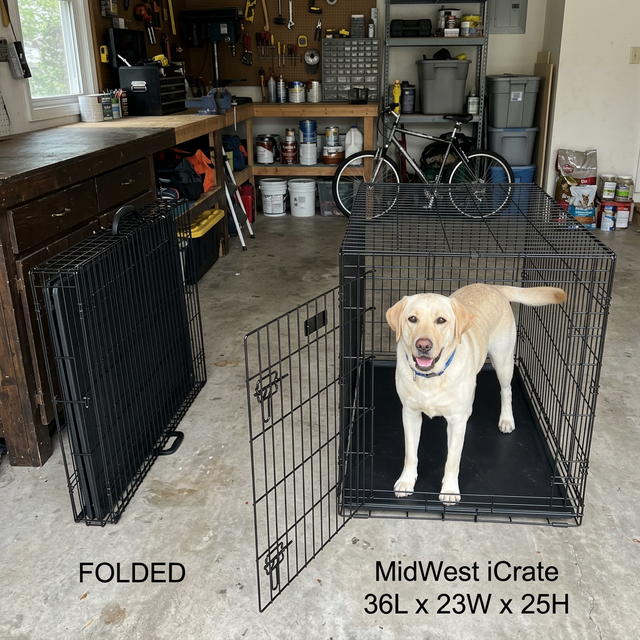
The iCrate folds flat in about 30 seconds, folded width is roughly 3 inches. The divider panel (visible in the assembled version) slides to any position as your dog grows.
The Diggs Revol uses aluminum alloy construction with a diamond-grid pattern mesh. It’s noticeably more solid, doors close with a satisfying click, latches are spring-loaded rather than slide-style, and the frame doesn’t flex. It also doesn’t have exposed sharp wire tips; every edge is finished.
Winner: Diggs Revol, by a significant margin, but the iCrate is more than adequate for most dogs.
Puppy Safety
This is where the Revol has the clearest advantage. The MidWest iCrate has standard wire grid spacing and exposed wire endpoints at the frame. Puppies (and brachycephalic dogs with squished faces) can catch paws, noses, and jaw skin in wire gaps.
The Revol’s diamond mesh pattern has smaller openings, rounded edge trim, and no exposed wire ends. From a puppy safety standpoint, it’s specifically engineered for this use case.
If you’re buying a crate for a puppy, especially a flat-faced breed, the Revol’s safety design is a legitimate reason to spend more.
Winner: Diggs Revol for puppies and brachycephalic dogs.
Folding and Setup
Both crates fold flat for storage. The experience is very different.
MidWest iCrate: Two-step fold, unlatch the sides, push down the top. Takes about 30 seconds. The folded crate is ~3 inches thick. To set it up, reverse the process and lift the bottom. It works, but takes two hands.
Diggs Revol: One-step fold, press a button and push. The whole thing collapses in 3–5 seconds. Set up is equally fast. You can genuinely do it one-handed.
If you’re frequently moving or storing the crate, the difference in daily use is meaningful.
Winner: Diggs Revol for ease of use.
Escape Resistance
The iCrate uses basic slide latches that determined dogs learn to open. Strong dogs can also flex the wire frame enough to create gaps. For calm, trained dogs it’s never an issue. For anxious or escape-prone dogs, it’s a real concern.
The Revol has spring-loaded double-latch doors and a more rigid frame that doesn’t flex. Most dogs don’t escape it without significant force. It’s not impact-rated (that’s a different category, see our review of impact dog crates), but it’s substantially more secure than the iCrate.
Winner: Diggs Revol for dogs with escape tendencies.
Aesthetics in an Apartment
The iCrate is utilitarian. It announces “this is a dog crate” from across the room. In an apartment where guests will see it, it’s hard to disguise.
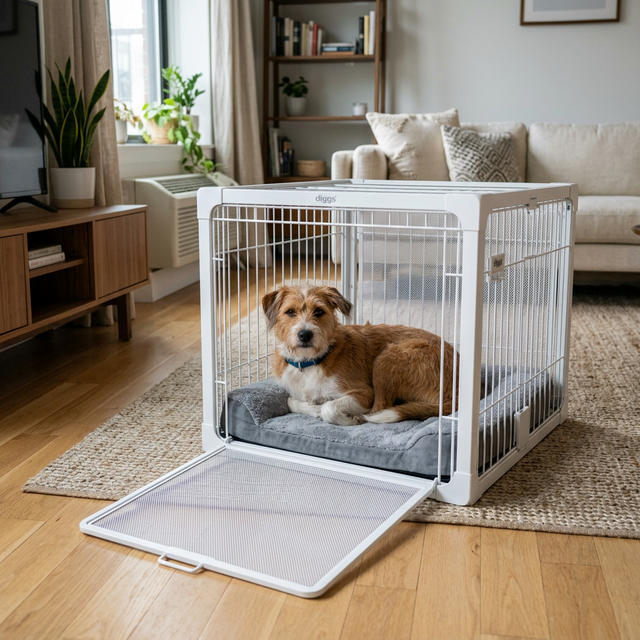
The Revol in white or charcoal blends into modern apartment interiors significantly better than standard black wire crates. The door folds completely flat rather than swinging into the room.
The Revol, especially in white or charcoal, resembles furniture you’d actually choose to put in a room. With the door folded flat, it looks closer to an end table than a crate.
Winner: Diggs Revol, not even close.
Who Should Buy Which
MidWest iCrate: First-time owners, calm dogs, budget-conscious buyers, secondary or travel crates, dogs who don’t need to crate long-term.
Diggs Revol: Apartment dwellers who care about aesthetics, puppy owners (especially flat-faced breeds), anxious dogs who escape standard wire crates, owners planning 5+ years of use.
Frequently Asked Questions
Can I use the MidWest iCrate for a French Bulldog puppy?
You can, but the exposed wire tips and larger grid spacing are a concern for flat-faced puppies who stick their faces into things. The Revol’s diamond mesh and rounded edges are specifically better for brachycephalic breeds.
Does the Diggs Revol come with a divider panel?
Yes. Like the iCrate, the Revol includes a divider panel so you can start small for a puppy and expand the space as they grow.
Is the Diggs Revol worth it for a calm adult dog?
Probably not. A calm adult dog who isn’t an escape artist doesn’t need the Revol’s safety features. The iCrate at $50 will work just as well. Save the $250 for food or vet bills.
Which crate is better for travel?
Both fold flat. The iCrate is lighter (~25 lb vs ~38 lb) and cheaper to replace if damaged. For travel, the iCrate is the more practical choice.
You Might Also Like
- Best Dog Crates for Apartments: Space-Saving Picks
- Best Dog Crates for Large Breeds
- How to Crate Train a Puppy
We evaluate pet products independently. To learn more about our editorial standards, read our Editorial Policy.
DogSupplyFinder Research Team
Product Research
Our research team analyzes ingredient lists, AAFCO feeding standards, safety specifications, and thousands of verified owner reviews, with particular attention to breed-specific needs such as brachycephalic breeds and dogs with dietary sensitivities. Evaluations prioritize safety specs, third-party certifications, and manufacturer quality controls over marketing language.
Dog Tips, Deals & Gear Guides
Expert buying guides, breed-specific product picks, and honest gear reviews. Plus our free New Puppy Checklist for subscribers.
📬 No spam, ever. Unsubscribe anytime. · Get the free puppy checklist