Front-Clip vs Back-Clip Harnesses: Which Is Best for Your Dog?
Front-clip harnesses redirect pulling dogs sideways. Back-clip prioritizes comfort. Compare both clip styles and dual-clip options for your dog.

DogSupplyFinder Research Team
Product Research ·
📖 Table of Contents
Most harness owners pick the wrong clip point — and then wonder why walks are still a wrestling match.
Here’s the thing: a harness is only as effective as where the leash attaches. Front-clip and back-clip harnesses look similar, but they work in completely different ways. One redirects pulling. The other prioritizes comfort. Choosing the wrong one for your dog’s behavior means you’re fighting physics on every walk.
Let’s break down exactly how each clip style works, who it’s best for, and how to pick the right one without overthinking it.
TL;DR: Front-clip harnesses redirect pullers by steering them sideways — great for training. Back-clip harnesses allow free movement and work best for dogs that already walk well. Dual-clip harnesses give you both options in one. Match the clip to your dog’s behavior, not the price tag. If you already know you need a front-clip no-pull model, jump to the no-pull harness picks.
Quick Summary Table
| Feature | Front-Clip | Back-Clip | Dual-Clip |
|---|---|---|---|
| Pulling control | Excellent — redirects dog sideways | Poor — can encourage pulling | Good — use front ring for control |
| Comfort | Moderate — can restrict gait | Excellent — natural movement | Good — depends on design |
| Training use | Best for leash manners | Not effective for pulling issues | Versatile for progressive training |
| Running/hiking | Not recommended — leash tangles | Ideal — full range of motion | Use back ring for activities |
| Ease of use | Moderate — leash can twist | Easy — simple attachment | Moderate — two ring options |
| Best for | Pullers, reactive dogs, training | Calm walkers, active dogs | Dogs in transition, multi-use |
How Front-Clip Harnesses Work
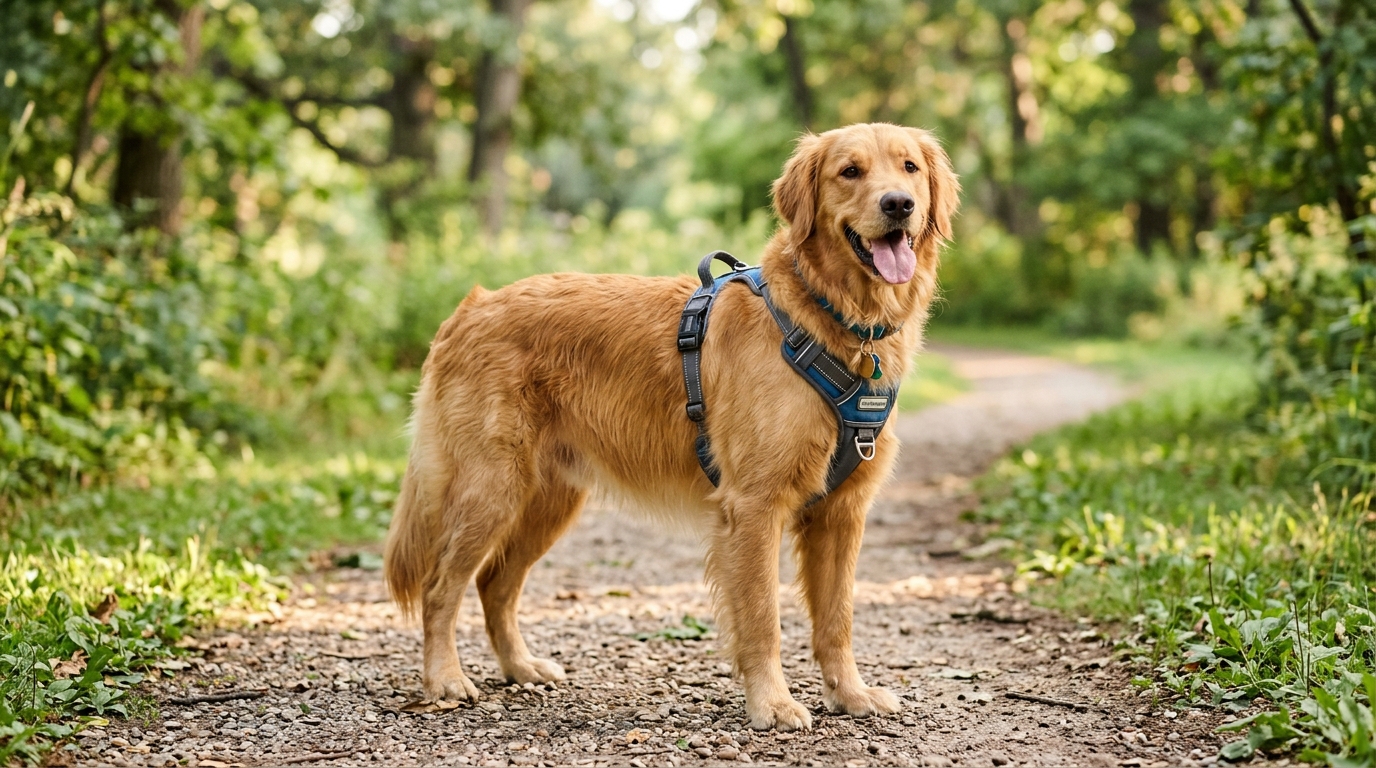
A front-clip harness has the leash attachment point on the chest strap, right at the center of your dog’s sternum. When your dog pulls forward, the leash tension naturally pivots their body sideways — back toward you.
It’s simple physics. The attachment point is off-center from the direction of force. Instead of your dog powering straight ahead with you dragging behind, the harness converts that forward momentum into a lateral turn. Your dog literally steers themselves back around.
This makes front-clip harnesses the go-to for pull reduction without using pain or correction. They don’t choke, pinch, or squeeze. They just make pulling mechanically inefficient.
When front-clip is the right call
Front-clip works best for dogs that are actively learning leash manners. If your dog lunges at squirrels, drags you toward other dogs, or treats every walk like a sled race, a front-clip harness gives you a real mechanical advantage.
It’s also solid for reactive dogs. That sideways redirect naturally breaks their forward focus, which can interrupt a reactive episode before it escalates.
The downsides
Front-clip harnesses aren’t perfect. The leash hangs down from the chest, which means it swings between your dog’s front legs. On longer walks, you’ll deal with tangling — especially if your dog zig-zags or circles.
There’s also a gait concern. Some front-clip designs sit too low on the shoulders and can interfere with your dog’s natural stride. Over time, this can cause compensatory movement patterns. Look for a Y-shaped chest strap that clears the shoulder joint entirely.
And here’s what nobody tells you: front-clip harnesses don’t teach your dog not to pull. They just make pulling less effective. You still need to pair it with actual training if you want lasting behavior change.
How Back-Clip Harnesses Work
A back-clip harness places the D-ring between your dog’s shoulder blades, right on top of the back. The leash runs straight up and behind, staying out of your dog’s way completely.
This design prioritizes freedom of movement. Your dog’s shoulders, chest, and legs are unrestricted. They can run, trot, and move naturally without anything swinging beneath them or pulling across their chest.
It’s comfortable. It’s simple. And for dogs that already walk nicely, it’s all you need.
When back-clip makes sense
Back-clip harnesses are perfect for dogs that don’t pull — or pull so lightly that it’s not an issue. Small dogs under 15 pounds, well-trained adults, and senior dogs who’ve mellowed out are all great candidates.
They’re also the better choice for active use. Running, hiking, bikejoring — any activity where your dog needs full range of motion and the leash needs to stay clear. Ever tried running with a front-clip harness? The leash turns into a jump rope between your dog’s legs within the first quarter mile.
The downsides
The biggest drawback is obvious: back-clip harnesses offer zero pull control. When your dog pulls, the force distributes evenly across their chest, which actually feels comfortable. There’s no redirect, no correction, no mechanical disadvantage.
In fact, this is exactly how sled dog harnesses work. They’re designed to make pulling easier. So if your dog already has a pulling habit, a back-clip harness will reinforce it.
Does that mean back-clip harnesses are bad? Not at all. It just means they’re the wrong tool for a pulling problem. You wouldn’t use a screwdriver to hammer a nail.
Dual-Clip: The Best of Both?
Dual-clip harnesses come with D-rings on both the chest and the back, giving you two attachment points in one harness. You pick the ring that matches the situation.
Training walk through a busy neighborhood? Clip to the front. Saturday morning trail run? Switch to the back. It’s the Swiss Army knife approach to harnesses.
How dual-clip systems really shine
The real power of dual-clip harnesses shows up when you use a double-ended leash. One end clips to the front ring, the other to the back ring. This gives you balanced control — the front provides steering while the back prevents the harness from shifting sideways.
It’s a setup that trainers love for dogs in the middle of leash training. You get the pull reduction of a front-clip with the stability of a back-clip. As your dog improves, you gradually transition to back-clip only.
The trade-off? Dual-clip harnesses tend to be slightly bulkier than single-clip designs. And the double-ended leash setup takes some getting used to — you’re managing two connection points instead of one. But for versatility, nothing else comes close.
Special Cases
Not every dog fits neatly into the “puller vs. calm walker” categories. Some breeds and life stages need extra consideration.
Brachycephalic breeds (flat-faced dogs)
Bulldogs, Pugs, French Bulldogs, Boston Terriers — these breeds already struggle with breathing. Any harness that puts pressure on the chest or throat is a problem. Back-clip harnesses are generally safest because they distribute pressure away from the airway. If you need pull control, choose a front-clip with a wide, padded chest strap that sits well below the neck.
Puppies
Puppies are still growing, and their joints are developing. Front-clip harnesses that sit across the shoulders can interfere with proper gait development during critical growth periods. Start puppies on a back-clip harness and introduce front-clip only when they’re physically mature — usually around 12-18 months depending on breed.
Pair any harness with positive reinforcement training from day one. Building good leash habits early means you might never need a front-clip at all.
Large and strong breeds
German Shepherds, Labrador Retrievers, Pit Bulls, Rottweilers — when a 90-pound dog decides to pull, you need every mechanical advantage you can get. Front-clip or dual-clip harnesses are almost always the right call for strong breeds that haven’t mastered loose-leash walking yet.
Look for harnesses with reinforced stitching and heavy-duty hardware. A plastic buckle won’t survive a full-speed lunge from an excited Lab.
Senior dogs
Older dogs often deal with arthritis, hip dysplasia, or general stiffness. A back-clip harness with a padded chest plate minimizes pressure on sore joints. Some harnesses designed for seniors also include a top handle — useful for helping your dog up stairs, into the car, or over obstacles on walks.
Which Clip Should You Choose?
Still not sure? Here’s the short version:
- Your dog pulls hard on walks → Front-clip or dual-clip harness
- Your dog walks calmly on a loose leash → Back-clip harness
- You’re actively training leash manners → Front-clip with positive reinforcement
- You run, hike, or bike with your dog → Back-clip harness
- Your dog is reactive to other dogs or people → Front-clip for redirect control
- You have a flat-faced breed → Back-clip with wide chest padding
- You have a puppy under 12 months → Back-clip; avoid front-clip until fully grown
- You want one harness for everything → Dual-clip with a double-ended leash
- Your senior dog has joint issues → Back-clip with padded, supportive design
The best clip style isn’t about brand or budget. It’s about matching the tool to your dog’s current needs — and being willing to switch as those needs change.
Frequently Asked Questions
Can I use a front-clip harness for running with my dog?
You can, but it’s not ideal. Front-clip harnesses cause the leash to swing beneath your dog’s chest, which creates tangling risk at speed. For running, a back-clip harness gives your dog full range of motion and keeps the leash out of the way. Switch to front-clip only for structured training walks.
Do front-clip harnesses hurt dogs or restrict their shoulders?
A properly fitted front-clip harness shouldn’t cause pain. However, some poorly designed models sit too low across the shoulder joint and can alter your dog’s natural gait over time. Look for harnesses with a Y-shaped chest strap that sits above the point of the shoulder, not directly over it.
Why does my dog pull more with a back-clip harness?
Back-clip harnesses don’t provide any steering correction. When your dog pulls, the pressure distributes evenly across the chest, which actually feels comfortable — so there’s no reason for them to stop. It’s the same principle behind sled dogs wearing back-clip designs. The harness makes pulling easier, not harder.
What’s the difference between a dual-clip harness and using two separate harnesses?
A dual-clip harness has both front and back D-rings built into one harness. You pick whichever attachment point suits the situation, or use both with a double-ended leash. Two separate harnesses would be bulky and uncomfortable. Dual-clip gives you flexibility without doubling the gear on your dog.
Related Articles
- Best No-Pull Harnesses
- 7 Signs Your Harness Doesn’t Fit
- How to Measure Your Dog for a Harness
- Best Harnesses for Flat-Faced Dogs
- Ruffwear Front Range vs Julius-K9
- How to Stop Your Dog From Pulling on the Leash
We evaluate pet products independently. To learn more about our editorial standards, read our Editorial Policy.
DogSupplyFinder Research Team
Product Research
Our research team analyzes ingredient lists, AAFCO feeding standards, safety specifications, and thousands of verified owner reviews, with particular attention to breed-specific needs such as brachycephalic breeds and dogs with dietary sensitivities. Evaluations prioritize safety specs, third-party certifications, and manufacturer quality controls over marketing language.
Related reading
Same cluster on this site — live guides only.
- Best No-Pull Dog Harnesses of 2026: Picks That Tame the Tugging
- Best No-Pull Harness for Large Dogs (Tested on 70+ lb Breeds)
- Best Dog Harness for Dogs That Pull: Tested on Strong Pullers
- Ruffwear Front Range vs Julius-K9: Which Harness Wins?
- How to Measure Your Dog for a Harness: Step-by-Step Fitting Guide
- 7 Signs Your Dog's Harness Doesn't Fit
Dog Tips, Deals & Gear Guides
Expert buying guides, breed-specific product picks, and honest gear reviews. Plus our free New Puppy Checklist for subscribers.
📬 No spam, ever. Unsubscribe anytime. · Get the free puppy checklist