How to Keep Your Dog Cool in Summer: 12 Practical Tips
Practical, vet-aligned strategies for keeping dogs safe in hot weather. Walk timing, cooling gear, hydration tricks, and breed-specific advice.

DogSupplyFinder Research Team
Product Research ·
📖 Table of Contents
Affiliate Disclosure: As an Amazon Associate, we earn from qualifying purchases. This comes at no extra cost to you and helps support our independent testing and reviews. We only recommend products we genuinely believe in.
Medical Disclaimer
This content is for informational purposes only and is not intended as a substitute for professional veterinary advice, diagnosis, or treatment. Always consult with a qualified veterinarian before making changes to your dog's care routine.
Medically reviewed by Dr. Sarah Mitchell, DVM, DVM
Licensed veterinarian. This article has been reviewed for medical accuracy.
Dogs can’t tell you they’re overheating until it’s serious. By the time a dog is showing obvious distress, heavy panting, unsteady gait, seeking shade, they may already be in dangerous territory. The work of keeping a dog cool happens before symptoms appear.
These are the strategies that actually make a difference, ranked roughly by impact.
1. Change Your Walk Schedule
The single highest-impact change you can make: stop walking dogs at midday in summer.
Air temperature peaks between 2-4pm, but ground temperature peaks later, pavement absorbs heat all day and stays hot into the evening. Walk dogs before 9am or after 7pm. Even then, test pavement temperature: press the back of your hand to the surface for 7 seconds. If you can’t hold it there, it’s burning your dog’s paws.
Short dogs (Dachshunds, Corgis, Basset Hounds) have their face closer to pavement heat and absorb more radiated warmth. They’re disproportionately affected by surface temperature.
2. Always Have Water Available
Dogs can’t ask for water. They’ll keep playing or walking until they collapse if you don’t offer water proactively. On hot-weather walks, bring more water than you think you need and offer it every 15-20 minutes rather than waiting until the dog is panting hard.
A dog that’s visibly thirsty is already mildly dehydrated. Thirst lags behind actual hydration status.
Good options:
- Collapsible silicone bowls weigh almost nothing and fold into a pocket
- Squeeze bottles with fold-out tray tops work well for on-the-go use
- Portable bottles with attached bowl allow one-handed operation
See our guide to the best dog water bottles for hikes and travel
3. Use a Cooling Mat Strategically
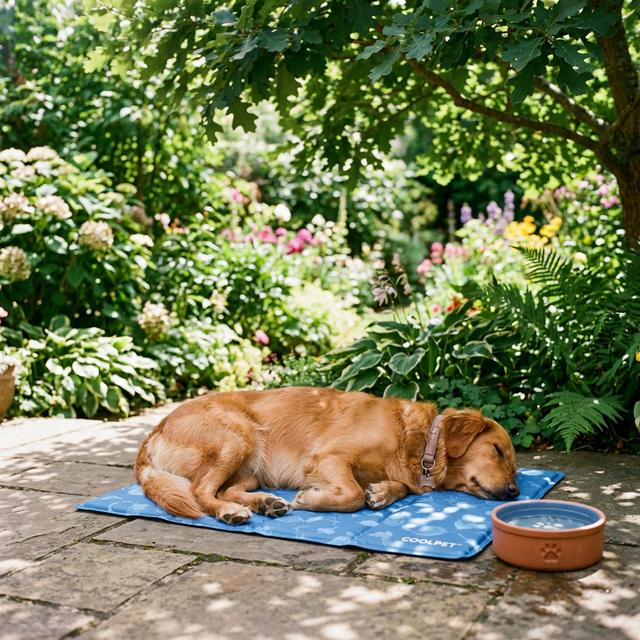
Cooling mats work by absorbing body heat from a dog lying on them. The best ones use phase-change gel that activates on contact pressure, no freezing required, they recharge at room temperature.
Placement matters more than the mat itself. A cooling mat in a sunny room is useless. Put it in the coolest part of your home, usually an interior room away from windows, or a tiled floor. Many dogs will find and use them without training once they discover the sensation.
See our full cooling mat guide
4. Set Up a Kiddie Pool or Splash Area
Wading in even a few inches of cool water drops body temperature fast. Most dogs will voluntarily wade if the water isn’t too cold or too deep. You don’t need an elaborate setup, a simple hard-plastic clamshell or foldable fabric pool does the job.
Position in shade and change the water every 1-2 days to prevent bacterial growth.
See our guide to the best dog pools
5. Provide Shade, True Shade
Doghouses are heattraps, not shelters. In hot weather, a wooden or plastic doghouse in direct sun reaches temperatures far above ambient air temperature, putting a dog inside one is dangerous. True shade means tree canopy, shade sails, or an overhang that allows air circulation.
If your yard lacks natural shade, a pop-up canopy or shade sail costs $30-80 and dramatically reduces heat exposure for outdoor dogs.
6. Run Air Conditioning (or Keep Fans Going)
Fans alone don’t cool dogs the way they cool humans. Human cooling relies on sweat evaporation, which fans accelerate. Dogs only sweat through paw pads, fans provide minimal cooling unless the dog is wet.
Air conditioning is the reliable option. If you leave your dog home in summer, the AC should stay on regardless of your absence. The energy cost is trivial compared to the risk of heatstroke in an enclosed space.
If AC isn’t available: tile floors stay meaningfully cooler than carpet. Direct your dog to the coolest room in the house, close south-facing curtains, and ensure airflow.
7. Use a Cooling Vest on Walks
Cooling vests use evaporation to lower the temperature of air around the dog’s core. They’re particularly effective during brief outdoor activities where you want to extend safe outdoor time slightly.
Soak in cool water, wring out most of the excess, then put on. They work for 20-45 minutes depending on heat and humidity before needing re-wetting.
Note: Cooling vests don’t make high temperatures safe, they extend the margin slightly. Still follow timing guidelines.
Browse cooling vests on Amazon
8. Freeze Treats and Meals
Frozen food adds novelty, enrichment, and mild internal cooling simultaneously. Options that work:
- Kong stuffed with peanut butter or wet food, frozen solid
- Broth ice cubes, low-sodium chicken or beef broth frozen in ice cube trays
- Frozen blueberries, most dogs love them, high in antioxidants
- “Pupsicles”, blend banana, peanut butter, and Greek yogurt, freeze in molds
These aren’t meaningfully cooling from a medical standpoint, but they encourage water intake and give dogs a positive hot-weather association.
9. Avoid Dog Parks at Peak Heat
Dog parks concentrate excited, running dogs in open fields during peak sun hours, the worst possible combination in summer. The social nature of dog parks means dogs push through discomfort to keep playing. Overheating at dog parks is extremely common.
If you use dog parks, go early morning or after dark. Bring your own water, park water bowls are often contaminated and may not be refreshed frequently.
10. Know Your Dog’s Specific Risk Level
Not all dogs handle heat equally. Adjust all the above based on your dog’s profile:
High-risk groups:
- Flat-faced breeds (French Bulldogs, Pugs, Bulldogs, Boston Terriers), their airways are physically less efficient at heat dissipation through panting
- Thick double coats (Huskies, Malamutes, Chow Chows), trap heat despite being adapted to cold climates
- Overweight dogs, fat insulates and prevents heat dissipation
- Senior dogs and puppies, impaired thermoregulation in both cases
- Dogs on certain medications, some antihistamines and cardiac medications affect heat tolerance
Lower-risk groups (still need basic precautions):
- Short-coated, athletic breeds with normal builds (Labs, Vizslas, Weimaraners)
- Sighthounds (Greyhounds, Whippets), lean with large surface area, generally heat-tolerant
11. Groom Appropriately, and Know What Not to Do
For single-coated breeds, keeping coats trimmed reduces heat absorption. For double-coated breeds (Huskies, Golden Retrievers, German Shepherds), do not shave, the double coat acts as insulation against both cold and heat, reflects sunlight, and shaving causes permanent coat damage.
Regular brushing removes the dead undercoat that traps heat most effectively. A well-deshedded double coat actually handles heat better than a matted, unkempt one.
12. Recognize the Signs of Overheating Early
The point of all the above is to prevent overheating. But knowing the signs means you can intervene before heatstroke sets in:
- Excessive panting that doesn’t slow at rest
- Bright red gums and tongue
- Heavy, ropey drooling
- Restlessness, seeking shade, lying flat on cool surfaces
- Vomiting, this is late-stage, requires immediate veterinary care
Full guide to heatstroke signs and emergency response
Frequently Asked Questions
What temperature is too hot to walk a dog?
There’s no single universal threshold, it depends on breed, fitness, surface type, and humidity. As a practical rule: above 85°F (29°C), shorten walks and schedule them in early morning or evening. Above 90°F (32°C), limit outdoor time to brief bathroom breaks for most dogs. Flat-faced breeds need more conservative limits at every temperature.
Do cooling vests actually work for dogs?
Yes, for extending outdoor time slightly. They work through evaporative cooling, moist fabric reduces the temperature of air near the dog’s body. They’re most effective in low-humidity conditions and need re-wetting every 20-45 minutes. They don’t make dangerous temperatures safe; they provide a moderate buffer.
Should I shave my dog in summer?
Only if your dog has a single coat (Poodles, Maltese, Yorkshire Terriers). For double-coated breeds (Huskies, Labs, German Shepherds, Golden Retrievers), shaving removes the insulating layer that also reflects heat and UV radiation. Shaved double coats often grow back with permanently altered texture and no longer insulate correctly.
For short-coated or light-pigmented dogs (especially white-haired breeds like Dalmatians and Bull Terriers), UV protection becomes important in summer. See our guide to safe dog sunscreen and sun protection products.
How much water should a dog drink in summer?
As a baseline, dogs need about 1 ounce of water per pound of body weight per day. In hot weather and during exercise, this increases significantly. A 60 lb dog doing moderate outdoor activity in 85°F heat may need 3-4x the baseline amount. Monitor by checking gum moisture, gums should feel slick and wet, never tacky.
You Might Also Like
DogSupplyFinder Research Team
Product Research
Our research team analyzes ingredient lists, AAFCO feeding standards, safety specifications, and thousands of verified owner reviews, with particular attention to breed-specific needs such as brachycephalic breeds and dogs with dietary sensitivities. Evaluations prioritize safety specs, third-party certifications, and manufacturer quality controls over marketing language.
Dog Tips, Deals & Gear Guides
Expert buying guides, breed-specific product picks, and honest gear reviews. Plus our free New Puppy Checklist for subscribers.
📬 No spam, ever. Unsubscribe anytime. · Get the free puppy checklist