Best Cooling Products for Dogs in Summer
Top cooling products for dogs in hot weather. Cooling mats, vests, pools, and bandanas compared for safety and effectiveness.

DogSupplyFinder Editorial Team
Editorial Team ·
📖 Table of Contents
Affiliate Disclosure: As an Amazon Associate, we earn from qualifying purchases. This comes at no extra cost to you and helps keep the DogSupplyFinder editorial desk publishing research-based guides. Recommendations come from specs and owner reports, not an in-house lab or a test fleet. See How We Make Money.
Listing check (cooling gear): match the mechanism on the spec sheet — pressure-activated gel, water-fill, or evaporative fabric — not the word “cooling” in the title. Confirm size against the dog stretched out (mats) or the brand’s girth chart (vests). Gel mats puncture; skip chew-prone dogs unless you will supervise. Prefer New; used gel pads arrive clumped or leaking. Check Amazon’s return window — a vest the dog will not wear is a common return. Recommendations come from specs and owner reports, not an in-house lab or a test fleet.
Dogs overheat faster than most owners realize. They can’t sweat through their skin, their only cooling mechanisms are panting and limited sweating through paw pads, and breeds with thick coats or flat faces are working against their own anatomy in hot weather.
Heatstroke can be fatal, and it comes on fast — within minutes, not hours. Cooling products aren’t just comfort items; for many dogs, they’re safety equipment.
Here’s what actually works, what’s marketing hype, and what the science says about each approach.
This page is the product ranking (mats, vests, pools, bandanas). Behavior and shade tactics are how to keep your dog cool in summer. Emergency signs are overheating and heatstroke and hot-weather safety. Paw-level heat is booties for hot pavement. The gear cluster is /accessories/.
Who this page is for — and when to skip
Use this ranking if: you need a mat for indoor rest, a vest for dry-heat walks, or a backyard pool. Skip an evaporative vest if: you live in 80%+ humidity — evaporation stalls and you bought a wet shirt. Skip a gel mat if: the dog shreds beds; punctured gel is a mess, not a cooler. Skip a $60 vest as the plan if: the apartment has no AC at 95°F — air conditioning and shorter walks beat fabric. Skip shaving a double coat “to cool them.” Skip ice-water dunks on an overheating dog (vessels clamp; heat stays inside). Skip this aisle entirely if: the dog is already panting hard, staggering, or vomiting — that is a vet trip, not a bandana. See heatstroke signs.
Desk note: “self-cooling” on Amazon is a keyword. Duration in hours and whether the SKU needs water or shade are the buying facts. Research-labeled prices below are snapshots, not live quotes.
| Job / dog | Buy | Skip |
|---|---|---|
| Indoor rest, AC on | Gel mat, supervise chewers | A hike vest that never leaves the hook |
| Dry-heat trail | Ruffwear-class evaporative vest | A gel mat in a backpack |
| Humid Gulf / Mid-Atlantic summer | Shade, water, shorter walks, indoor mat | Expecting a vest to “work like the desert” |
| Flat-faced (Frenchie, Pug, Bulldog) | Earlier cutoff, AC, vest only as extra | A long noon walk “because they have a vest” |
| Backyard, water-loving dog | Folding pool in shade | A pool in full sun that becomes a warm bath |
| 10-minute potty walk | Wet bandana or skip gear | A $65 vest for a sidewalk loop |
| Hot pavement | Grass routes or booties | Assuming a vest protects paws |
How Dogs Regulate Temperature
Understanding the mechanism helps you choose the right products:
- Panting evaporates moisture from the tongue and upper respiratory tract. This is the primary cooling mechanism.
- Paw pad sweating contributes minimally. Hot pavement actually makes this worse because it heats the paws.
- Conduction — lying on cool surfaces transfers heat from the body to the surface. This is where cooling mats work.
- Evaporative cooling — wetting the coat lets evaporation draw heat away. This is where cooling vests work.
Flat-faced breeds (Pugs, Bulldogs, French Bulldogs) are worst at panting because their shortened airways make breathing less efficient. These dogs need cooling products earlier and more aggressively than long-snouted breeds. A tight collar or a poorly fitted walk harness on a hot brachy is extra airway load — fit those first, then add a vest.
Cooling Mats
How They Work
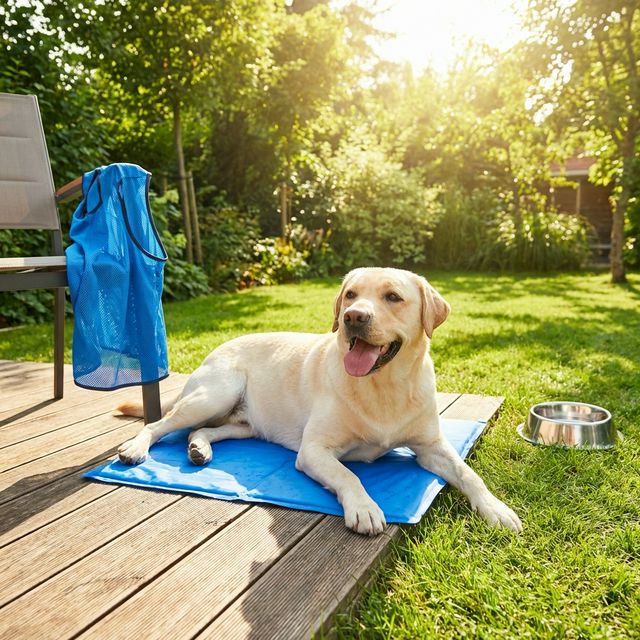
Pressure-activated gel mats absorb body heat when the dog lies on them. The gel draws heat away through conduction. No electricity, no refrigeration — the gel responds to body pressure.
Water-based mats require soaking in water. The evaporation provides cooling. These tend to be cooler than gel mats but need refilling.
Best Options
The Green Pet Shop Self-Cooling Pad Pressure-activated gel, no water or electricity needed. Lasts 3-4 hours before the gel warms to body temperature. Recharges itself after 15-20 minutes of non-use. Wipes clean.
Research range: about $25–$50 depending on size Best for: Indoor and outdoor use, dogs that won’t chew
On the listing, match The Green Pet Shop and the size that fits a sprawl, not a curl photo. Skip chew-prone dogs unless you will stay in the room.
Check Green Pet Shop cooling pad on Amazon
Arf Pets Self-Cooling Mat Similar pressure-activated gel technology with a slightly more durable cover. Available in larger sizes for big dogs. Non-toxic gel in case of puncture.
Research range: about $20–$40 Best for: Budget option, similar performance to Green Pet Shop
On the listing, match Arf Pets gel mat and the stated dimensions. Cover fabric photos get reused across sizes.
Check Arf Pets cooling mats on Amazon
K&H Cool Bed III Water-based cooling bed that connects to a hose for continuous cooling or can be filled and used standalone. Provides significantly more cooling than gel mats but requires water and setup.
Research range: about $30–$60 Best for: Outdoor use in extreme heat, dogs that spend extended time outside
On the listing, match Cool Bed III, not a K&H heated pad in the same brand aisle. Water-fill SKUs need a hose or a tub — skip if you are in a no-patio studio (use gel indoors, or a crate-adjacent mat on apartment crates).
Check K&H Cool Bed III on Amazon
Cooling Vests
How They Work
Soak the vest in water, wring it out, and put it on your dog. As the water evaporates, it pulls heat from the body. Same principle as a wet towel, but designed to stay in place, distribute cooling evenly, and last longer.
Best Options
Ruffwear Swamp Cooler The industry standard for cooling vests. Three-layer construction: a wicking outer layer, water-absorbent middle, and comfortable inner layer. Reflective trim for visibility. Side release buckles for easy on/off. Provides 1-2 hours of cooling per soak depending on humidity and activity.
Research range: about $50–$65 Best for: Active dogs, hiking, outdoor activities in heat
On the listing, match Swamp Cooler and the girth chart. Jet Stream is a lighter sibling — do not mix SKUs. Confirm New; used evaporative foam is already packed with mineral crud.
Check Ruffwear Swamp Cooler on Amazon
Ruffwear Jet Stream A lighter version of the Swamp Cooler for less extreme conditions. Thinner and more breathable, with less cooling capacity but better comfort for less active dogs.
Research range: about $40–$50 Best for: Casual walks, moderate heat, dogs that overheat easily but aren’t doing intense activity
On the listing, match Jet Stream. If the dog is a freight-train puller, fit the puller harness under or instead of stacking two chest systems that shift.
Check Ruffwear Jet Stream on Amazon
Kurgo Core Cooling Vest Evaporative cooling with reflective outer material. Less expensive than Ruffwear with solid performance. The buckle system is simpler.
Research range: about $20–$35 Best for: Budget-friendly cooling vest option
On the listing, match Kurgo Core Cooling. Size to girth, not weight. Marketplace “cooling vest” tiles often show a fleece winter coat.
Check Kurgo Core Cooling vest on Amazon
Effectiveness Note
Evaporative cooling vests work best in dry heat. In high humidity, evaporation slows significantly, reducing the vest’s effectiveness. In areas with 80%+ humidity, a cooling vest provides minimal benefit. Use cooling mats and access to water/shade instead.
Portable Dog Pools
A dog-specific kiddie pool gives dogs the most effective cooling option: full-body water immersion.
Foldable Dog Pool (various brands) Collapsible PVC pools that fold flat for storage. Available in sizes from 32” to 63” diameter. No inflation needed — rigid sides pop up and hold shape.
Research range: about $20–$50 depending on size Best for: Backyard cooling, dogs that love water
Tip: Place in shade. A pool in direct sun becomes a warm bath within an hour. Refresh water when it feels warm to the touch.
On the listing, match foldable / pop-up (not an inflatable ring that a nail pops). Measure the patio; a 63-inch pool in a 70-inch balcony is a skip.
Check foldable dog pools on Amazon
Cooling Bandanas
The simplest cooling product. Soak a bandana in cold water, wring it out, tie it around the dog’s neck. The neck has major blood vessels close to the surface, so cooling the neck cools the circulating blood.
All Absorb / crystal cooling bandanas Uses water-absorbing crystals that hold moisture longer than plain fabric. Soak for 5 minutes, squeeze, and wrap around the neck.
Research range: about $8–$15 Best for: Quick trips, walks, and dogs that won’t tolerate a full vest
On the listing, match a soak-and-wrap bandana, not a winter fleece scarf. Do not cinch it like a tight collar — two fingers still apply (collar sizing). PetSafe’s cool bandana is a known budget SKU.
Check PetSafe cooling bandana on Amazon
A frozen KONG Classic is indoor busywork that also drops core heat a little. It is not a heatstroke plan.
What to Know About Heat Safety
Warning Signs of Overheating
| Stage | Signs | Action |
|---|---|---|
| Early | Heavy panting, drooling, red gums | Move to shade, offer water, apply cooling |
| Moderate | Stumbling, glazed eyes, vomiting | Wet dog with cool (not cold) water, go to vet |
| Severe | Collapse, seizure, unconscious | Emergency vet immediately — wet with cool water during transport |
Breed Risk Levels
| High Risk | Moderate Risk | Lower Risk |
|---|---|---|
| Bulldogs, Pugs, French Bulldogs | Labs, Goldens, Huskies | Lean breeds, short-coated breeds |
| Obese dogs of any breed | Senior dogs | Young healthy adults |
| Dark-coated dogs | Thick double-coated breeds | Dogs acclimated to heat |
Pavement Temperature Rule
If you can’t hold the back of your hand on the pavement for 7 seconds, it’s too hot for your dog’s paws. Asphalt reaches 140°F+ when air temperature is only 85°F. Walk on grass, or walk during early morning and evening. Bootie picks: best dog booties for hot pavement.
Car interiors spike faster than sidewalks. Do not leave a dog in a parked car “with the cooling mat.” Restraints for actual drives are on dog car seats.
Comparison Table
| Product | How It Cools | Duration | Best For | Research range |
|---|---|---|---|---|
| Gel cooling mat | Conduction | 3-4 hours | Indoor/shade resting | $20–$50 |
| Cooling vest | Evaporation | 1-2 hours | Active outdoor use | $20–$65 |
| Portable pool | Immersion | Continuous | Backyard, water-loving dogs | $20–$50 |
| Cooling bandana | Evaporation | 30-60 min | Quick walks, simple option | $8–$15 |
| Frozen KONG | Internal cooling | 30-60 min | Indoor mental stimulation | $10–$20 |
What Doesn’t Work
Shaving double-coated dogs. The double coat provides insulation against heat AND cold. Shaving removes the insulating layer and exposes the undercoat to direct sun, which can actually increase overheating risk plus cause sunburn. Brush out the undercoat instead.
Ice water baths. Extremely cold water causes blood vessels near the skin to constrict, which traps heat inside the body — the opposite of what you want. Use cool water, not ice water, when cooling an overheated dog.
A tighter collar or a “cooling collar” that cinches the throat. Airway restriction is not cooling. Keep ID on a correctly fitted collar and walk force on a harness.
For more seasonal gear, see our winter dog gear guide and travel gear for dogs.
Frequently Asked Questions
At what temperature is it too hot to walk my dog?
As a general rule, limit walks when air temperature exceeds 85°F (29°C), and avoid pavement walking above 80°F. In high humidity, lower the threshold by 5-10 degrees. Early morning (before 8 AM) and evening (after 6 PM) walks are safest in summer.
Do cooling vests work for brachycephalic breeds?
Yes, but they’re not sufficient alone. Flat-faced breeds overheat faster than cooling vests can compensate. Use a cooling vest alongside shade access, limited exercise, and water availability. In extreme heat (90°F+), keep brachycephalic dogs indoors in air conditioning.
Can I put ice in my dog’s water bowl?
Yes. Despite internet myths, ice water does not cause bloat. Cold water is perfectly safe and many dogs prefer it in hot weather. Add ice cubes to the water bowl freely.
You Might Also Like
DogSupplyFinder Editorial Team
Editorial Team
Every recommendation on DogSupplyFinder starts with the paperwork — AAFCO guidelines, AVMA guidance, safety specifications — and ends with what real owners report after months of daily use. Rankings are never paid for.
Related reading
Same cluster on this site — live guides only.
- Best Dog Booties for Hot Pavement (2026): Heat-Safe Picks That Stay On
- How to Keep Your Dog Cool in Summer: 12 Practical Tips
- Hot Weather Safety: Preventing Heatstroke in Dogs
- Signs Your Dog Is Overheating, and What to Do Immediately
- Dog Walking Safety Tips for Every Season
- Best Dog Winter Gear: Coats, Boots, and Cold Weather Essentials
Dog Tips, Deals & Gear Guides
Expert buying guides, breed-specific product picks, and honest gear reviews. Plus our free New Puppy Checklist for subscribers.
📬 No spam, ever. Unsubscribe anytime. · Get the free puppy checklist