Best Dog Booties for Hot Pavement (2026): Heat-Safe Picks That Stay On
Best dog booties for hot pavement: heat-safe soles and stay-on fit. Measure all four paws so summer sidewalk boots do not fall off.

DogSupplyFinder Editorial Team
Editorial Team ·
📖 Table of Contents
Affiliate Disclosure: As an Amazon Associate, we earn from qualifying purchases. This comes at no extra cost to you and helps keep the DogSupplyFinder editorial desk publishing research-based guides. Recommendations come from specs and owner reports, not an in-house lab or a test fleet. See How We Make Money.
Medical Disclaimer
This content is for informational purposes only and is not intended as a substitute for professional veterinary advice, diagnosis, or treatment. Always consult with a qualified veterinarian before making changes to your dog's care routine.
Listing check (booties): measure each paw width while the dog is standing, then match that brand’s chart — not a weight range or a lifestyle photo. Confirm the pack is New, and whether you are buying a set of four or two pairs. Ruffwear Grip Trex listings are pairs.
As an Amazon Associate we may earn a commission from qualifying purchases made through links on this page, at no extra cost to you.
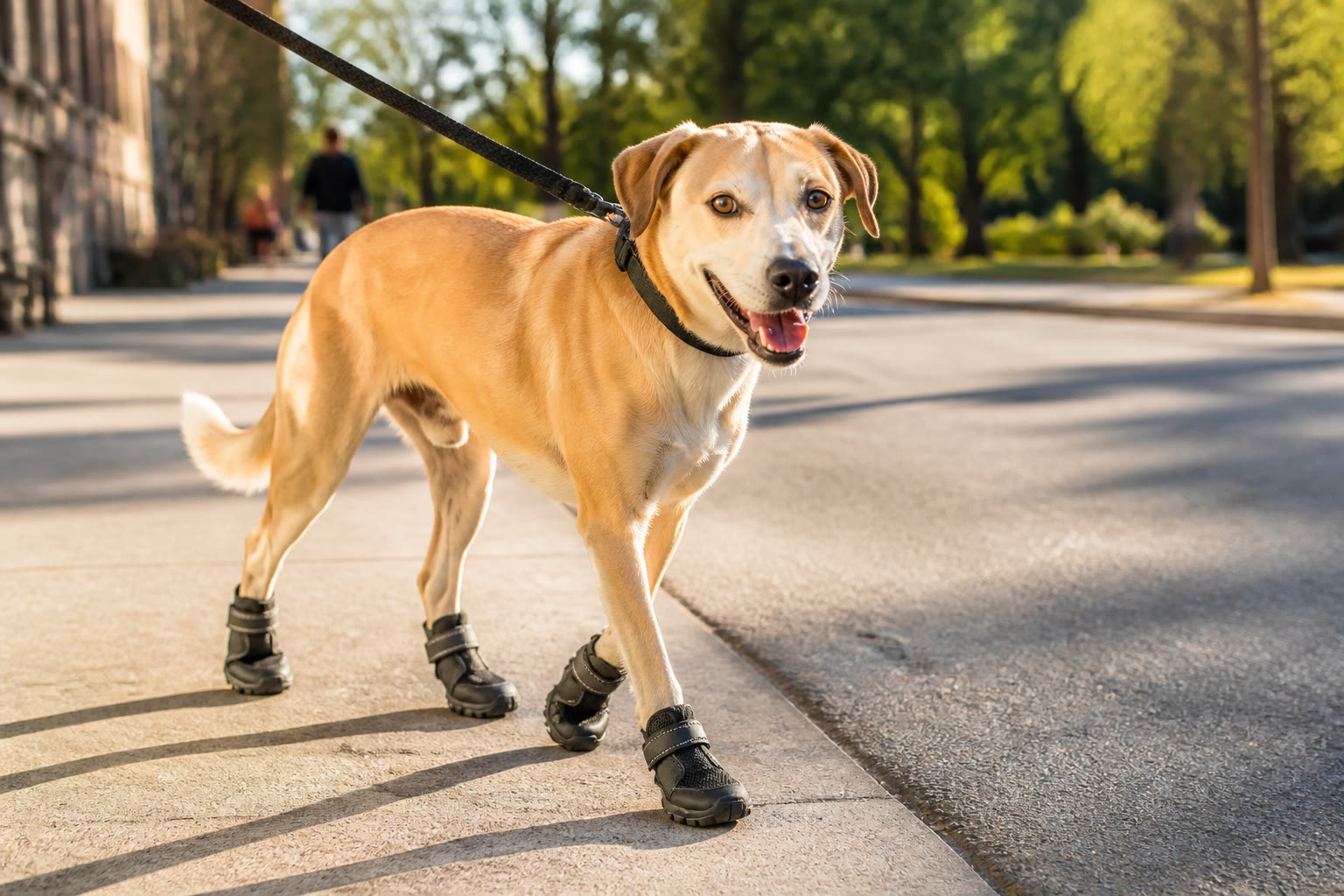
The question that shows up in YouTube shorts and owner threads is almost never “do booties exist.” It is “these things will not stay on” and “the sidewalk is cooking my dog’s feet.” Search those phrases and you get winter boot roundups, brand size charts, and clips of a dog high-stepping down a hallway. What is thin is a summer-specific buying page: sole that actually blocks asphalt heat, a closure that survives a trot, and a measurement method that does not pretend all four paws are the same.
This is that page. It is a research-based comparison of booties sold for hot pavement — specs, brand sizing rules, and what owners report after the first week — not a test-fleet trial. Confirm the current size chart and that the Amazon offer is New before you click.
Paw burns and heatstroke are different problems. Booties protect pads. They do not cool a flat-faced dog on a noon jog. Pair this guide with the seven-second pavement test in our walking-safety article and the summer cooling checklist. If the dog is already wobbly or panting like a broken engine, skip gear and follow overheating first aid.
Why hot pavement is a pad problem, not a “toughen up” problem
Dogs dump some heat through panting and a little through paw pads. The AKC’s heatstroke overview is clear that pads are a minor cooling path, not armor. When the surface under those pads is hotter than skin, you have reversed the system: the walk is adding heat.
Air temperature lies. Black asphalt soaks sun all afternoon and stays hot after the air has dropped. A mid-80s day is enough for many city blocks to sit around 140°F on the surface — the number that shows up in AKC and veterinary summer warnings as second-degree burn territory in under a minute. The seven-second hand test is crude and useful: if you will not park your own skin there, do not park a pad there.
Short dogs (Dachshunds, Corgis) live closer to that radiating slab. Seniors and dogs with thin, cracked, or recently shaved pads burn sooner. Puppies have softer pads and no vote. Brachycephalic breeds add a second risk: they overheat in the body while the sidewalk cooks the feet. Booties do not fix the airway. They only stop the pad injury so you can cut the walk short and get to shade.
Grass medians, morning shade, and “we’ll only go around the block” are still a plan. Booties are for the days you cannot change the route.
Booties vs wax vs skipping the walk
| Tool | What it actually does on hot asphalt | Buy it when |
|---|---|---|
| Rubber- or Vibram-soled boot | Puts a physical gap between pad and slab | Midday errands, city sidewalks, parking lots |
| Soft-soled “sock boot” | Stops grit; little insulation | Indoor traction, not July blacktop |
| Paw wax | Thin, lick-safe film; some abrasion help | Dogs that refuse footwear; short hops; cracked pads |
| Change the clock | The only zero-gear fix that always works | You can walk before 9 a.m. or after the slab cools |
Wax is not a failed boot. It is a different product. Musher’s Secret is a food-grade wax originally used on sled dogs. It conditions pads and blocks salt and grit. On 140°F asphalt it is a delay, not a wall. If the only honest walk is across a supermarket lot at 2 p.m., buy a sole.
Winter boots from the cold-weather gear guide — Polar Trex, fleece Muttluks — are the wrong aisle. Insulation that is a gift on ice is a heat trap in August.
What to look for in a hot-pavement bootie
A sole you can describe. You want a rubber, Vibram, or TPE bottom with some thickness, not a felt slipper. Mesh uppers are for airflow. The heat break is the outsole. If the listing photo shows a sock with dots, it is a gripper, not a summer sidewalk boot.
Stay-on geometry, not “adjustable” as a vibe. The strap has to cinch above the stopper (metacarpal/metatarsal) pad, on the narrowest part of the lower leg, without sitting on the dewclaw. Ruffwear’s published fit language is specific: little left-right slop, the boot bends where the paw bends. Most Amazon 4-packs fail because the cuff is a tube on a cone-shaped leg.
Sold how? Grip Trex is sold in pairs, because front paws are often wider. A $22 4-pack that is “size 5 for 40 lb dogs” is a lottery ticket. If your dog’s fronts measure 2.6” and the rears 2.3”, you need two sizes, not one box.
Breathable upper. Closed neoprene or fleece is a winter move. For summer, look for mesh, vents, or a rubber wellie with holes (WagWellies Mojave). A sealed winter boot on hot pavement can cook the pad inside the boot if it fills with trapped heat and sweat.
Dewclaw cutout or a cuff that sits below it. A strap that saws a dewclaw is why dogs suddenly “hate boots” on day two.
Listing must match the model. “Dog shoes for hot pavement” is a search dump. Confirm Grip Trex vs Polar Trex, Mojave vs winter Wellies, QUMY mesh vs QUMY waterproof winter, Walkee Paws boot-legging vs a random sock set.
How to measure so the first pair is not a return
Do this on a hard floor, dog standing, not sitting.
- Put a piece of paper under one paw. Lift the opposite paw so the measured paw is weight-bearing and splayed.
- Hold a pen vertical. Mark the widest points left and right.
- Measure that width. Repeat for all four paws. Write the numbers down.
- Compare to that brand’s chart. Ruffwear sizes by width in inches (a 2.50” paw is a 2.5). QUMY publishes width × length boxes and a weight band — trust the width, treat weight as a sanity check.
- If you are between sizes, Ruffwear’s public guidance is to size down. A slightly snug boot stays on; an oversized boot rotates and comes off. Other brands differ. Read the chart you are buying, not a forum guess.
Nails should be short enough that they are not punching the toe of the boot. A long nail rotates the boot on every step. That is a nail-trim problem pretending to be a product problem.
The picks
1. Ruffwear Grip Trex — Best overall sole and stay-on system
The Grip Trex is the boot other summer lists keep returning to, and the reason is the outsole: a Ruffwear-designed Vibram rubber tread, not a printed “anti-slip” pattern on foam. Mesh upper, hook-and-loop plus hardware at the narrowest part of the leg, padded lining. The brand sells them for mixed terrain — trail rock, wet roots, and hot pavement — which is the honest use case for a city dog who also hits a park path.
Buying notes that the title hides
- Pairs, not fours. One Amazon size is two boots. A dog with bigger fronts needs two ASINs or two size selections. Budget for that before you compare “set of 4” prices.
- Measure width, size down if split. Ruffwear’s own fit copy: snug left-to-right, strap above the stopper pad, boot flexes at the natural bend.
- Colorways share a last. Obsidian Black vs a seasonal print is not a different last. Confirm the inch size in the variation dropdown, not the thumbnail.
- Liner socks are optional, not a fit fix. A sock can stop a tiny amount of slip and reduce rub. It will not save a boot that is a full size long.
Best for: Daily summer sidewalks plus weekend dirt. Dogs whose owners will measure.
Trade-offs: Price (often ~$50 per pair, so ~$100 to shoe a dog with mixed paw sizes). Thicker sole means a longer indoor high-step phase than a floppy rubber wellie.
2. Wagwear WagWellies Mojave — Best dedicated hot-weather rubber
Wirecutter’s 2026 boot test called the WagWellies Mojave the hot-weather pick: a ventilated rubber boot, not a hiking tank. Lighter and easier to rinse than Grip Trex. Velcro strap, dewclaw slits on the design, wipe-clean. The point of this silhouette is summer: air moves, the sole still sits between pad and slab, and you are not carrying winter insulation.
Buying notes
- Confirm Mojave, not a closed winter Wellie. The vented sage/rubber look is the summer SKU.
- Size from Wagwear’s chart, not a “L = Labrador” guess. Rubber has less give than mesh.
- Color is a visibility choice. Bright wellies are easier to spot if one works loose in tall grass; they do not change the last.
Best for: Urban loops, patio-to-park, dogs that overheat in tall mesh towers.
Trade-offs: Not a granite-trail boot. Rubber can still pick up city grit; rinse the tread so it does not act like sandpaper on the next walk.
3. QUMY mesh 4-pack — Best budget sidewalk set (if the width matches)
QUMY’s hot-pavement 4-packs are what most people actually click: mesh, reflective strap, rubbery sole, eight sizes, one box, under $30. For a dog whose four paws land in the same size box, they are a reasonable first try. For a dog with a 0.3” front/rear split, they are why Reddit thinks “all booties fall off.”
Buying notes
- Use the width × length table on the listing (Size 5 is 2.4” × 2.8”, and so on). Ignore the pound range if it disagrees with the paper trace.
- The listing title says “medium large” on many sizes. That is ad copy. Size 1 is a small paw.
- Reflective strap material is a wear item. If the hook-and-loop pills after a month, the boot can still work; if the sole delaminates, retire that foot.
- Buy New from a seller that ships a matched set. Marketplace mix-and-match sizes show up in this aisle.
Best for: One-size-paw dogs, apartment-to-park sidewalks, a spare set you will not mourn if one is lost.
Trade-offs: Stay-on and sole life are a step down from Grip Trex. Not the boot for a daily 5-mile asphalt commute unless the fit is unusually lucky.
4. Walkee Paws boot-leggings — Best when every ankle boot gets kicked off
If the failure mode is “on the lawn in 40 yards,” stop buying better ankle boots and change the architecture. Walkee Paws connect all four TPE booties through a suspender/legging panel over the back. A single boot that slips is still attached. The maker’s own copy is the stay-on pitch: no squeezing a cuff on a cone-shaped leg as the only retention.
Buying notes
- Size is back length + leg height, not paw width alone. A short-backed Corgi and a long-backed dachshund are different SKUs (including “tall” variants).
- TPE soles are flexible and the brand claims high heat tolerance on the compound. They are still a molded rubber-like shoe, not Vibram lugs. Fine for sidewalks; not a substitute for Grip Trex on scree.
- Some dogs need a session to accept fabric on the belly/back. That is clothing, not a boot. Treats, indoor laps, then the block.
- Patterns (hearts, solids) share a pattern of adjusters. Read the size name, not the print.
Best for: Kickers, dogs with dewclaw drama from ankle straps, rainy-plus-hot cities where you also want a cleaner door.
Trade-offs: Warmer than four separate mesh boots. Awkward for a male dog who needs a fast potty break if you have not practiced the on/off. Not a hiking crampon.
5. Ultra Paws Durable — Soft wrap for light sidewalks, not a hiking plate
Ultra Paws Durable is a wrap-and-Velcro boot with a softer sole. Independent hiking write-ups treat it as light-duty: non-abrasive surfaces, dogs that need something between pad and ground, including small sizes other trail boots skip. The Rugged line is the heavier sibling; do not mix the names in the cart.
Buying notes
- Measure weight-bearing width the same way as Ruffwear. Soft wraps hide a sloppy size until the first canter.
- Good as a “my dog has a raw pad and we still have to cross the driveway” boot. Weak as the only shoe for a parking-lot commute on blacktop at 3 p.m.
- Made-in-USA wrap construction shows up in owner threads as easier to get on a folded paw than a stiff rubber cup.
Best for: Small paws, post-injury walks on mixed surfaces, a backup pair.
Trade-offs: Less insulation than a thick rubber outsole. Confirm Durable vs Rugged vs any winter SKU.
6. Musher’s Secret — Best no-boot backup (not a 140°F plan)
Musher’s Secret stays in this article because owners ask for it in the same YouTube comment as the boots. Rub a thin layer into the pads and between the toes. It absorbs. It is lick-safe food-grade wax. It helps cracked pads and salt. It does not replace a sole when the hand test fails.
Buying notes
- 60 g / 2.1 oz is the common jar. You need a film, not a cake. Extra wax picks up grit and becomes sandpaper.
- Apply before the walk, not after a burn. After a burn, you are in vet territory.
- Confirm Dilmont / Musher’s Secret, not a generic “paw butter” with a different ingredient list.
Best for: Dogs that panic in any footwear; dawn/dusk walks on warm (not scalding) concrete; pad conditioning.
How to keep booties on after they fit
Fit is 80% of stay-on. The last 20% is a two-minute walk and a re-cinch.
- Put boots on indoors. Feed. Walk the hallway. Reward motion, not standing there like a goat.
- Recheck straps after the first 60–90 seconds outside. Webbing and fur settle.
- If a boot rotates, it is usually too long or the strap is on the wide part of the leg.
- Vet wrap under a cuff is a last-resort field fix, not a sizing strategy. Tight wrap cuts circulation. If you need it every walk, the boot is wrong.
- High-stepping for a block is normal. Refusing to move after five minutes of treats is a fit or pain problem. Pull the boots and look for a nail fold, dewclaw pinch, or grit inside.
Ruffwear’s break-in advice matches every decent trainer clip: soften a stiff sole in your hands, start short, check for rub. A boot that stays on but sands a wrist raw is not a win.
A 10-minute intro that is not a fight
- One boot, one treat, off. Repeat until the dog offers the paw.
- Two boots (a pair), hallway walk, jackpot.
- Four boots, 3 minutes indoor, off before the dog claws at them.
- First outdoor session on grass or a cool morning sidewalk — not the first 95°F errand.
Do not “surprise” the dog at the car. That teaches boots = trapped.
If the dog has a history of panic in gear, work with the same patience you would use for a muzzle or a harness. The harness fit signs article is about chests, but the rule is the same: redness after a session is data.
When the answer is still “do not walk there”
Booties are not a license for a noon fetch session on a black schoolyard. Heatstroke can start in minutes. Dr. Jerry Klein, AKC Chief Veterinarian, puts the danger at a body temperature above 105.8°F and notes that time-at-temperature is what does the organ damage. Pads can be fine in boots while the dog’s core is not.
Use shade, water, and a cooling vest or mat for the body. Use booties for the slab. Use the clock when you can. For trail days, the hiking guide still wants water, a first-aid bit, and an honest temperature plan — booties are one line on that list, not the list.
After a walk, check pads anyway. A slipped boot leaves a circular rub. A too-thin sole leaves a pad that is darker, shiny, or blistered. That is a vet same-day problem, not another Amazon size.
How this page stays out of the winter-boot fight
Best Dog Winter Gear covers Polar Trex, fleece Muttluks, and salt. This URL is summer slab and stay-on fit. If you need both seasons, you likely need two designs: a vented rubber or Vibram mesh for July, an insulated cuff for January. One “all-season” 4-pack that is fleece inside is a winter product wearing a summer title.
Frequently asked questions
How many booties do I buy? Four feet. If fronts and rears differ, two pairs in two sizes. Count before you compare “per set” prices.
Can I put boots on only the front paws? You can. You should not. The rears still land on the same asphalt, and the gait looks like a skipping record.
Do black boots make pavement worse? The sole is what matters. A thin black sock is still a sock. A thick black Vibram sole is still a gap. Upper color is visibility and fashion.
My dog licks the boots. Check for grit inside and a strap on a dewclaw. Then go back a step in the intro. Licking can also mean the pad already hurts — look before the next block.
Are disposable balloon boots (Pawz-style) enough? They keep grit off and some dogs accept them. They tear, they collect water, and they are a weak heat break. Fine as a backup in the glove box. Poor as the only July plan.
The short version
If you cannot hold your hand on the pavement for seven seconds, the dog needs a sole or a different walk. Measure all four weight-bearing paw widths. Buy the chart, not the weight band. Grip Trex if you will pay for a real outsole and you understand it is sold in pairs. Mojave if you want a vented summer wellie. QUMY if all four paws share a size and you want a cheap first set. Walkee Paws if ankle boots keep landing on the lawn. Wax if the dog refuses footwear and you can stay off the worst slab.
Re-cinch after a minute. Retire a boot that rotates or rubs. And remember: cool pads in a boot do not mean a cool dog. Shade and water still run the day.
DogSupplyFinder Editorial Team
Editorial Team
Every recommendation on DogSupplyFinder starts with the paperwork — AAFCO guidelines, AVMA guidance, safety specifications — and ends with what real owners report after months of daily use. Rankings are never paid for.
Related reading
Same cluster on this site — live guides only.
- Best Cooling Products for Dogs in Summer
- How to Keep Your Dog Cool in Summer: 12 Practical Tips
- Hot Weather Safety: Preventing Heatstroke in Dogs
- Signs Your Dog Is Overheating, and What to Do Immediately
- Dog Walking Safety Tips for Every Season
- Best Dog Winter Gear: Coats, Boots, and Cold Weather Essentials
Dog Tips, Deals & Gear Guides
Expert buying guides, breed-specific product picks, and honest gear reviews. Plus our free New Puppy Checklist for subscribers.
📬 No spam, ever. Unsubscribe anytime. · Get the free puppy checklist