Muzzle for Dogs: Types, Fit, Training, and When It's the Right Call
A straight guide to dog muzzles: basket vs soft, brachycephalic fit warnings, drinking and panting ability, acclimation steps, and honest use cases.

DogSupplyFinder Editorial Team
Editorial Team ·
📖 Table of Contents
Affiliate Disclosure: As an Amazon Associate, we earn from qualifying purchases. This comes at no extra cost to you and helps keep the DogSupplyFinder editorial desk publishing research-based guides. Recommendations come from specs and owner reports, not an in-house lab or a test fleet. See How We Make Money.
Listing check (muzzle): measure snout length and circumference in inches with a soft tape (snout length from the tip of the nose to just below the eyes; circumference around the widest part with the mouth closed) and match those to the brand’s chart — not S/M/L labels, which have no standard meaning across makers. Confirm basket vs sleeve construction, because listing photos mix them constantly. Buy New; a used muzzle is someone else’s failed fit. Recommendations here come from specs and owner reports, not an in-house lab or a test fleet.
A muzzle is the most misunderstood piece of dog equipment on the shelf. It gets treated as an admission that the dog is dangerous — so owners avoid it, and then the one moment they desperately need one (an injured dog in pain, a scared dog at an emergency vet) is the moment they’re wrestling a strange plastic thing onto a panicked animal for the first time.
The destigmatized version is simpler: a muzzle is safety equipment, like a leash or a car harness. Veterinary behaviorists routinely recommend conditioning every dog to a muzzle — not because every dog is aggressive, but because any dog can bite when hurt or frightened, and a dog that’s comfortable in a muzzle gets handled sooner and safer in an emergency.
This page is the how-it-works guide: types, fit, training, and when a muzzle is the right tool. The product ranking with specific model picks is 7 Best Dog Muzzles. Vet-visit stress generally is on how to keep your dog calm at the vet. The behavior side of reactivity is leash reactivity and understanding dog aggression. Reading what your dog is telling you before it escalates: dog body language.
Who this page is for — and when a muzzle is the right tool
Legitimate, common reasons to use a muzzle:
- Injured dog handling. Pain is the most common cause of bites, including from dogs that have never shown aggression. A dog hit by a car or with a broken limb needs a muzzle before it’s moved — this is exactly the emergency every dog should be pre-conditioned for.
- Vet and grooming visits where handling hurts or scares the dog — injections, nail trims, wound care.
- A veterinary behaviorist or certified trainer recommends one as part of a behavior modification plan for reactivity or aggression.
- Legal requirement — breed-specific legislation in some jurisdictions, or muzzle orders after a bite incident.
- Recovery from injury or surgery — preventing licking or chewing at stitches when a cone won’t stay on or the dog can reach around it.
- Known scavengers on walks (a basket muzzle stops garbage and dead-wildlife dining where training hasn’t caught up yet).
When a muzzle is the wrong tool: as a punishment (“he chewed the couch, so now he wears it”), as a fix for boredom barking, as a permanent substitute for a behavior plan, or as a way to “test” whether a dog with a bite history can be trusted at the dog park. A muzzle manages risk in defined situations; it does not train anything, and it must never become all-day equipment.
Desk note: if the reason you’re shopping is a bite that broke skin, the muzzle is step two. Step one is a certified behavior professional — how to find a good dog trainer — and possibly your vet, because pain and medical issues drive a surprising share of “sudden” aggression.
Basket vs soft muzzles — the difference that matters
Basket muzzles (the default answer)
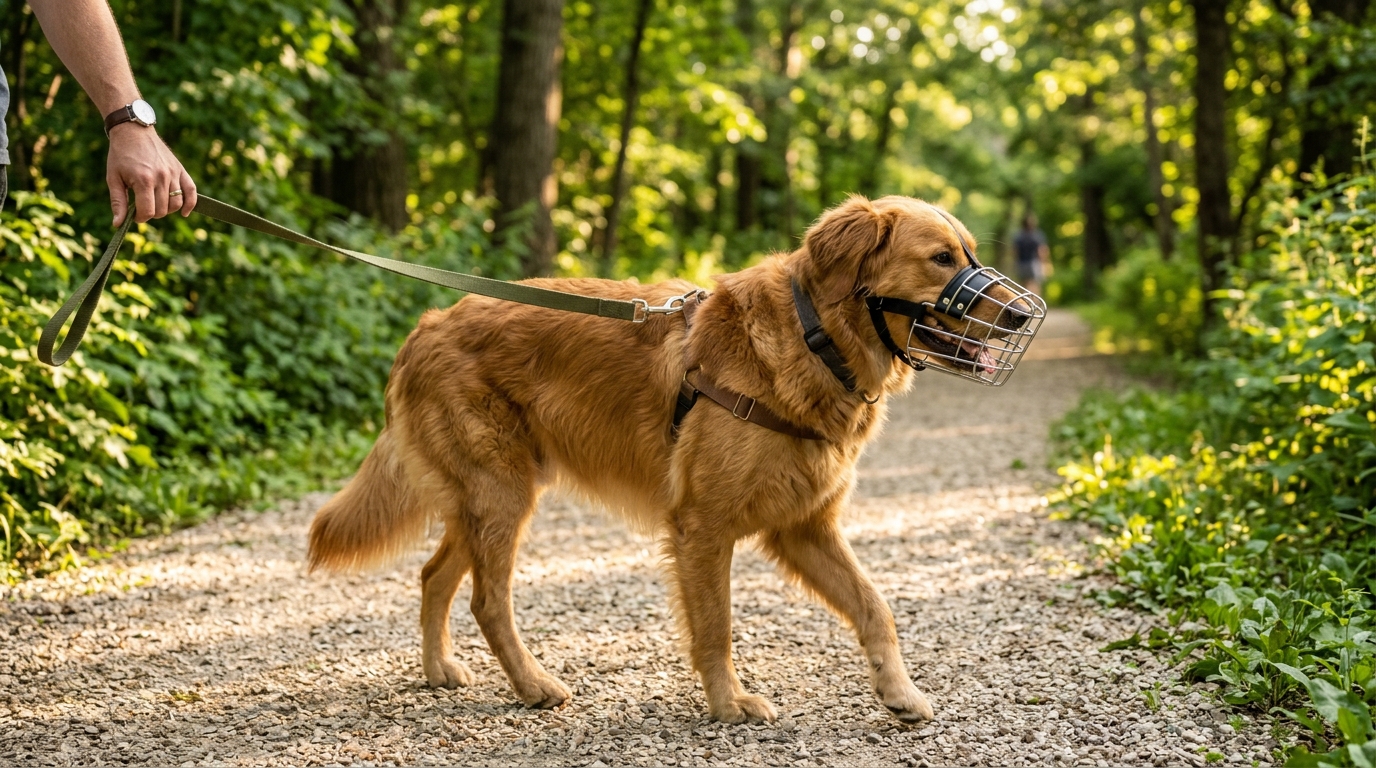
A cage or basket around the snout — plastic, rubber, silicone, biothane, or wire — that holds its shape and lets the dog open its mouth inside it. Because the mouth can open:
- the dog can pant, which is how dogs cool themselves — non-negotiable for any wear beyond a few minutes, and doubly so in heat or stress, both of which raise body temperature
- the dog can drink water (through most basket designs)
- the dog can take treats through the openings — which is what makes positive conditioning possible at all
- barking is muffled and biting is prevented, but breathing is unrestricted
This is the category for walks, vet visits, and any use longer than a couple of minutes. If you remember one sentence from this page: if the dog can’t pant, it’s the wrong muzzle for the situation.
Within the category, material choice is mostly fit and durability: moldable thermoplastic (the Baskerville class) can be warmed and shaped to the snout; wire baskets are the most escape- and crush-resistant for strong dogs; silicone and biothane are lightweight, easy to clean, and a common starting point for training.
Soft (sleeve) muzzles — minutes only
A fabric loop that pulls the mouth closed around the snout. It stops biting, but it also stops panting, drinking, and treat-taking — which means it stops being safe quickly. Soft muzzles are for short, supervised, hands-on moments: a quick injection, a nail trim, checking an injury. Not walks, not car rides, not hot days, not “while I’m at work.” A dog that can’t pant in a warm car or on a summer walk is a heatstroke risk, and the stress of wearing one can make the next handling attempt harder.
Most owners who think they need a soft muzzle actually need a basket they’ve conditioned the dog to — the sleeve is the fallback in the drawer, not the daily tool.
Fit and breed issues — including the brachycephalic warning
Muzzles are the least one-size-fits-all product in dog gear, because skulls vary more than necks or chests do.
Measure first, always: snout length (nose tip to just below the eyes) and snout circumference (widest point, mouth closed), in inches, against the brand’s chart. Weight and breed labels are proxies; two “70-lb pit mixes” can need different sizes. A good basket fit: no more than about a finger of space at the sides of the nose, the basket not pressing the eyes or dragging on the ground, straps snug enough that the dog can’t scrape it off with a paw, and — critically — enough length that the dog can fully open its mouth to pant without the basket’s end stopping the jaw.
Long, narrow snouts (Greyhounds, Collies, GSDs): the classic basket problem — a basket that fits the length is often too roomy at the tip, and one that fits the circumference is too short to allow panting. Sighthound-specific and adjustable-length baskets exist for exactly this reason; a generic “large” usually fails one direction or the other.
Broad, short snouts (Pit bulls, Boxers, Staffies): need wide, blunt baskets; long-pointed designs sit off the nose and get pawed off. Several makers sell broad-snout wire or biothane baskets specifically for this head shape.
The brachycephalic warning: flat-faced breeds (French Bulldogs, English Bulldogs, Pugs, Boston Terriers) are the hardest dogs to muzzle safely, because there is barely any snout to work with and their airway is already compromised. A standard basket has almost nothing to attach to, and anything that restricts what little airflow they have is dangerous — brachycephalic dogs also overheat faster than average, so panting restriction is doubly serious. Short-snout-specific designs (a mesh cup over the muzzle rather than a cage extending ahead of it) exist, but they restrict panting more than a true basket, so the rules are stricter: gradual conditioning, short wear, close supervision, heat avoidance, and a vet or behaviorist in the loop for anything beyond occasional use. If you own a flat-faced dog and are muzzle shopping, read the brachycephalic breeds overview first — the safest answer may be a different management plan entirely.
Puppies: condition to a light basket early if your vet or trainer suggests it, sized for now, not for adulthood.
Muzzle training: the acclimation steps
Never clap a muzzle on and go. The goal is a dog that sees the muzzle and pushes its nose in on its own — and that is entirely trainable with a couple of weeks of short sessions.
- Show, pay, repeat. Hold the muzzle out; the dog sniffs it; mark (click or “yes”) and treat. The muzzle predicts cheese. 2–3 minutes, a few times a day.
- Feed through it. Put treats through the basket bars so the dog voluntarily puts its nose in to eat. Don’t strap anything yet.
- Nose in, pause, out, pay. Wait for the dog to hold its nose in for a second or two before paying at the far side of the basket. Build duration gradually.
- Brief buckle. Clip the strap, treat, unclip within a second or two. Build up: a few seconds of wear, treats flowing, strap off before the dog worries at it.
- Wear around the house, with treats and normal life happening, always supervised. If the dog paws at it, help with a treat scatter — don’t scold; you’re building voluntary buy-in.
- Take it on the road: yard, then short walk, then a routine vet visit that’s all cookies and no procedure. The first real “event” should be boring by design.
Handle the strap area with extra care — dogs are commonly head-shy about ears and the back of the skull, so pair strap handling with food separately before you combine. And throughout: if the dog freezes, panics, or claws at it, you went too fast; drop back a step. For the general reward-based framework, see positive reinforcement vs punishment. A dog with a serious bite history needs this plan built with a professional, not from a web page.
Muzzle rules of use
- Supervised only. A muzzled dog can still paw, rub, and snag a basket on things. Never leave one on an unattended dog.
- Pant-ability check: you should be able to slide a couple of fingers between the basket end and the dog’s nose while the mouth opens wide inside it.
- Time limits: a fitted basket is fine for a walk or a vet visit; it is not for eight hours. Skin checks after wear — rub marks mean refit.
- Heat and stress both raise panting needs. Extra caution on warm days and in high-stress moments (which includes the vet lobby).
- Clean between uses; plastic and wire baskets wash with soap and water. A biothane or silicone basket dries fastest for regular use.
- Carry it before you need it. A conditioned dog plus a muzzle in the car or the emergency kit turns a roadside injury from a bite risk into a manageable scene. For the rest of that kit: dog first aid basics.
- A muzzle is management, not a cure. Keep the training plan going underneath it.
Frequently Asked Questions
Can a dog eat, drink, or pant in a basket muzzle?
Pant and drink, yes — that’s the point of the basket design. Eating full meals, no; taking treats through the openings, yes (that’s how you train with it on). Sleeve muzzles prevent all three, which is why they’re limited to brief, supervised handling moments. If a planned situation involves food, heat, or duration, it’s a basket situation.
Can I muzzle my dog to stop barking?
No. A muzzle is not an anti-barking device. A dog can still vocalize in a basket, and using a sleeve to clamp the mouth shut against barking is stressful, risks overheating, and addresses none of the reasons the dog is barking. Find the cause first — how to stop nuisance barking — or if you were considering a bark collar instead, our honest take is on bark collars, including who they’re actually appropriate for.
How tight should a muzzle be?
Snug enough that the dog can’t scrape it off with a paw or rub it off on the grass, loose enough at the nose that the mouth opens fully to pant inside the basket — roughly a finger’s width of give at the strap. Rub marks on the snout after wear mean it’s too tight or the wrong shape; a muzzle the dog can paw off in one motion is a fit failure, not a training failure.
Do I have to use a muzzle forever?
Usually not. Most muzzle use is situational — vet visits, recovery, a training period while a behavior plan matures. As the underlying training or medical issue resolves, the muzzle typically retires to the emergency kit. Dogs with a serious bite history may wear one in public long-term by professional recommendation, but that’s a specific case, not the rule.
You Might Also Like
DogSupplyFinder Editorial Team
Editorial Team
Every recommendation on DogSupplyFinder starts with the paperwork — AAFCO guidelines, AVMA guidance, safety specifications — and ends with what real owners report after months of daily use. Rankings are never paid for.
Related reading
Same cluster on this site — live guides only.
- How to Teach Your Dog a Reliable Recall (Come Command)
- How to Teach a Bulletproof Recall ('Come' Command)
- How to Stop Your Dog From Pulling on the Leash (Loose-Leash Walking)
- How to Stop Nuisance Barking: Finding the Root Cause
- How to Stop a Puppy From Biting: Proven Training Methods That Work
- How to Potty Train a Puppy: The Only Method That Works
Dog Tips, Deals & Gear Guides
Expert buying guides, breed-specific product picks, and honest gear reviews. Plus our free New Puppy Checklist for subscribers.
📬 No spam, ever. Unsubscribe anytime. · Get the free puppy checklist